When investors begin exploring mutual funds, they often come across categories such as large-cap, flexi-cap, ELSS, and index funds. But one category that creates curiosity because of its concentrated approach is Focused Funds.
The name itself raises questions. Does a focused fund mean a fund manager invests with greater conviction? Does concentration increase returns? Or does it also increase risk?
For many investors, the first reaction is confusion. After all, most mutual funds spread investments across dozens of stocks. So why would a fund intentionally limit itself to fewer companies?
To understand this better, imagine two cricket teams. One team depends equally on every player, while another depends heavily on a few star performers. If those players perform, the team wins comfortably. If they fail, results suffer. That is broadly how Focused Funds work.
This article explains what a focused fund is, the focused fund’s meaning, how these schemes work, their risks and rewards, and whether they deserve a place in a long-term portfolio.
What is a Focused Fund?
The simplest answer to what is focused fund is that it is a category of mutual fund that invests in a limited number of stocks.
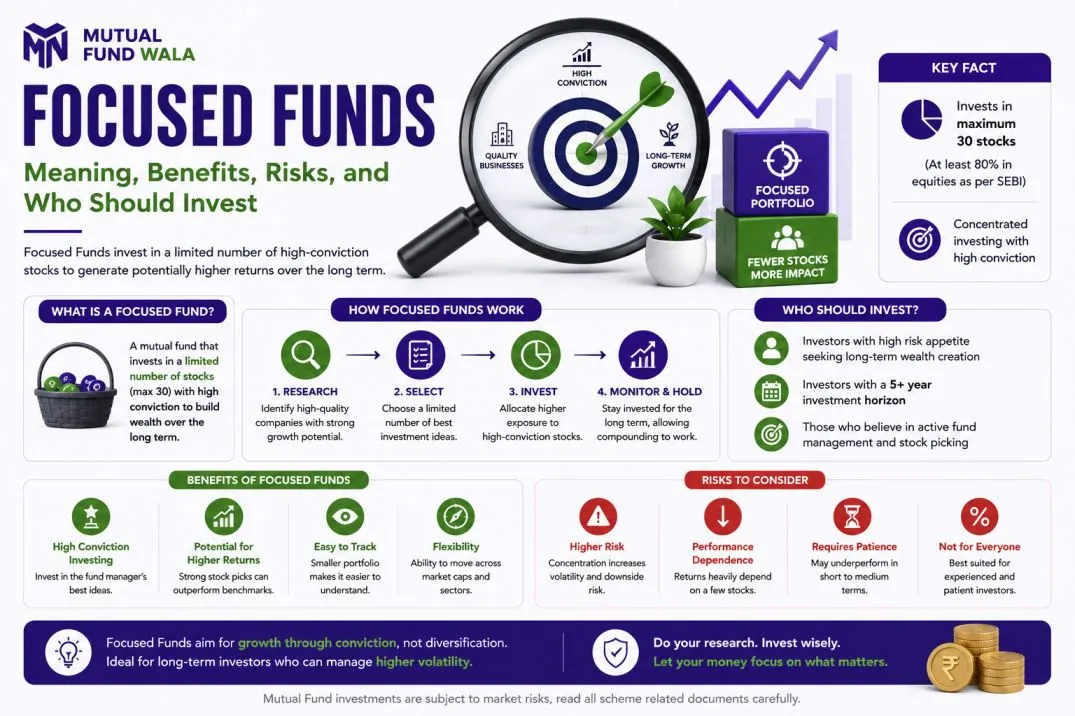
The Securities and Exchange Board of India (SEBI) mandates that focused funds invest at least 80% of their total assets in equities, spread across a maximum of 30 stocks. Unlike diversified equity funds that may hold 50-100 stocks, a focused strategy intentionally limits exposure to a smaller basket of companies.
The idea is simple. Instead of spreading money across many businesses, fund managers invest in their strongest ideas with higher conviction.
If a fund manager strongly believes that certain companies have long-term growth potential, they may allocate larger portions of the portfolio to those stocks.
This is the core focused fund meaning. Rather than diversifying widely, these schemes aim to create concentrated portfolios that reflect high-conviction investing.
Focused Fund Meaning in Simple Language
The easiest way to understand the focused fund’s meaning is to think about personal investing behaviour.
Suppose Rahul has ₹1 lakh to invest in stocks.
One strategy would be to spread the money across 50 companies so that no single investment affects overall returns too much.
Another strategy would be to carefully research and invest only in 12-15 businesses he strongly believes in. This second approach resembles how Focused Funds operate.
The mutual fund manager selects a limited number of companies across sectors and market capitalisations while maintaining a concentrated portfolio. Because the portfolio is smaller, every stock selection matters more.
What are Focused Funds and How Do They Work?
Many investors ask what are focused funds and how they differ from regular equity funds.
The biggest difference lies in concentration.
A diversified fund spreads investments widely to reduce company-specific risk. A focused strategy keeps investments limited.
For example, a diversified flexi-cap fund may hold 70 stocks, whereas a focused fund may hold only 20 to 30 stocks.
This means each investment carries greater weight in portfolio performance.
Under SEBI regulations, a focused fund must explicitly state its market-capitalisation focus, such as large-cap, mid-cap, small-cap, or multi-cap, in its mandate.
For example, a Large-Cap Focused Fund is restricted to larger companies and cannot invest heavily in small caps. However, many focused funds intentionally choose a multi-cap or flexi-cap mandate.
It is this specific structure that gives fund managers the flexibility to hunt for high-conviction opportunities wherever they see value, provided they stick to the 30-stock limit. As a result, some investors even compare focused investing with a concentrated version of flexi cap investing.
What is a Focused Mutual Fund and Why Do Investors Consider It?
Many beginners searching online ask what is focused mutual fund is and why someone would invest in one despite higher concentration risk.
The answer lies in potential outperformance.
A fund manager who identifies winning businesses early may generate superior returns because higher allocations to successful stocks create a stronger impact on portfolio performance.
For example, imagine a diversified fund allocates only 1% to a high-growth stock while a focused strategy allocates 7%. If that company performs exceptionally over several years, the focused portfolio may benefit more meaningfully.
This possibility attracts investors who believe in active fund management and long-term stock picking.
However, concentration works both ways. A wrong investment decision can hurt returns more sharply. That is why understanding what is focused mutual fund also means understanding risk.
Benefits of Focused Funds
High Conviction Investing
The biggest attraction of Focused Funds is concentrated investing.
Fund managers invest more aggressively in their strongest ideas rather than spreading money too thinly.
This creates the possibility of better returns if stock selection works well.
Potential for Better Alpha Generation
Since portfolio concentration is higher, strong stock selection can improve outperformance relative to benchmark indices. This is one reason some investors researching the best focused fund prefer managers with strong stock-picking track records.
Simpler Portfolio Structure
A focused portfolio is easier to track.
Instead of owning exposure to dozens of businesses, investors gain exposure to a smaller basket of carefully chosen companies.
Risks of Focused Funds
Higher Volatility
The biggest risk is concentration. If a few stocks perform poorly, returns may suffer significantly.
For example, if a portfolio heavily depends on sectors facing temporary stress, investors may see sharper corrections compared to diversified funds.
Heavy Dependence on Fund Manager Skill
In Focused Funds, stock selection matters more than ever. The success of the strategy depends heavily on fund manager quality and conviction.
This is why investors often spend time researching portfolio strategy before evaluating the best focused mutual funds for long-term investing.
May Underperform During Market Rotation
Different market phases reward different sectors. A concentrated portfolio may lag diversified peers if the manager’s chosen sectors temporarily underperform.
Who Should Invest in Focused Funds?
Before selecting a focused fund, it is also helpful to compare it with other top-performing categories. Explore our guide to the best mutual funds to invest in 2026 to evaluate different options based on your investment goals.
Not every investor needs exposure to Focused Funds.
These funds may suit investors who:
- Have a high risk appetite
- Can tolerate temporary volatility
- Believe in active management
- Have a long-term investment horizon of at least 5 to 7 years
For example, an experienced investor building wealth for retirement over two decades may consider allocating a portion of equity exposure to focused strategies.
However, someone seeking stability or investing for near-term goals may prefer diversified categories. The key lesson in understanding what focused funds are is this: concentration increases both opportunity and risk.
How to Choose Focused Funds Wisely
Choosing a fund only because someone labels it the best-focused fund may not be the right approach.
Instead, investors should examine:
Fund Manager Track Record
Since concentrated investing depends heavily on stock selection, consistency matters.
Portfolio Strategy
Understand where the fund invests. Does it lean toward large caps or smaller companies? Is sector concentration extremely high?
Risk Adjusted Performance
Rather than looking only at returns, compare volatility and downside behaviour.
Investment Horizon
Focused investing often works better when investors remain patient through market cycles. This is especially important when evaluating discussions around the best focused mutual funds, because short-term performance alone can be misleading.
Are Focused Funds Better Than Diversified Funds?
There is no universal winner. A diversified fund offers stability and a wider risk spread.
Focused Funds offer concentrated bets and the potential for higher alpha. Think of it like owning a restaurant business.
One owner operates multiple small outlets across cities to reduce risk. Another builds a premium restaurant with high confidence. Both approaches can work.
The better choice depends on investor temperament, risk tolerance, and investment goals.
Conclusion
Understanding Focused Funds helps investors move beyond headline returns and appreciate how portfolio strategy influences outcomes. At Mutual Fund Wala, we believe that understanding a fund’s investment approach is just as important as evaluating its performance.
The focused fund’s meaning revolves around concentrated investing through a smaller basket of stocks selected with conviction. These funds can deliver meaningful returns when stock selection works, but they can also experience sharper volatility when bets go wrong. Mutual Fund Wala encourages investors to assess both the opportunities and risks associated with concentrated portfolios.
For investors asking what a focused fund is or what a focused mutual fund is, the answer lies in balance. Focused investing is neither inherently good nor bad. It simply represents a different style of portfolio construction.
For long-term investors comfortable with risk and volatility, focused strategies may complement a diversified portfolio. But for beginners, moderation and diversification should remain the foundation of wealth creation – a principle strongly advocated by Mutual Fund Wala.
FAQs
Like This Blog? Share With Others


 Shashi Kant Bahl