Best Mutual Funds to Invest in 2026

Best Mutual Funds to Invest in 2026
Best Mutual Funds to Invest in 2026 Image

The search for the best mutual funds to invest in 2026 is less about chasing past returns and more about identifying strategies that can navigate an evolving market cycle.

After a period of strong equity performance, valuations in some markets have become selective, making disciplined fund selection critical. This is even more crucial amid geopolitical headwinds.

Investors now need to look beyond headline returns and focus on portfolio construction, consistency across cycles, and risk management.

The coming year is likely to reward funds that balance growth with valuation discipline, adapt to changing liquidity conditions, and maintain allocation flexibility.

This makes the choice of fund category and strategy as important as the fund itself.

Against this backdrop, this article examines five mutual funds for 2026.

Parag Parikh Flexi Cap

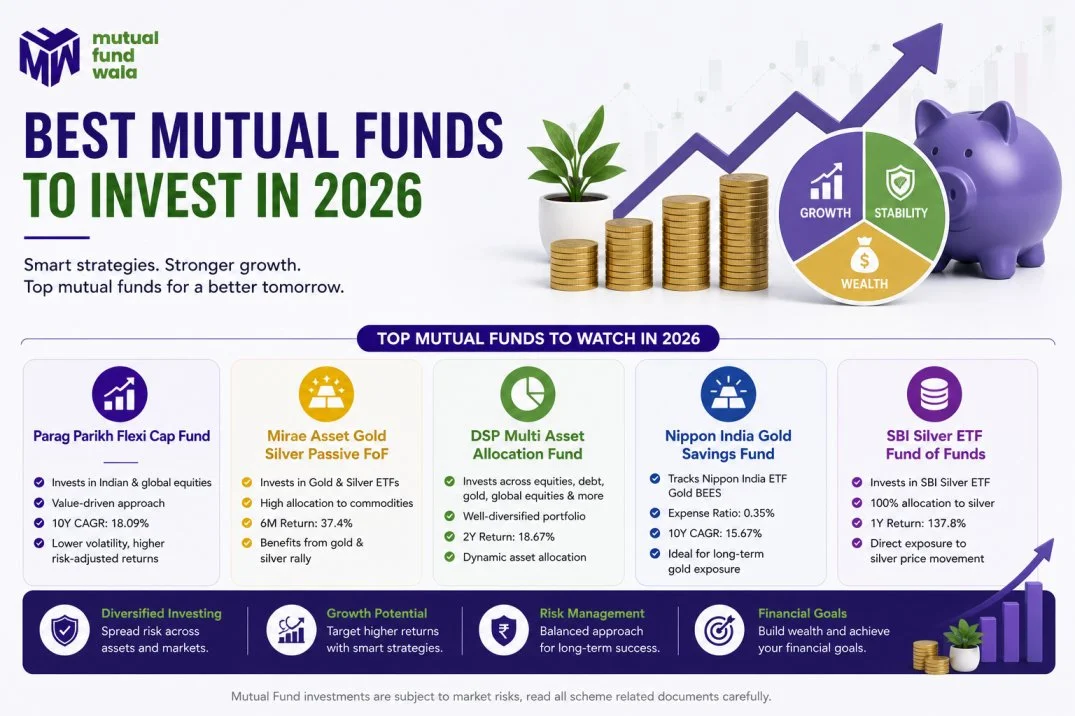
Parag Parikh Flexi Cap Fund has built a distinct identity within the flexi cap fund category, mainly due to its ability to invest in both Indian and global equities.

This adds a layer of diversification that most peers do not offer.

The fund follows a value-driven approach, focusing on businesses with steady cash flows and avoiding expensive growth bets. As of 31 March 2026, it had an AUM of ₹128,966 crore, with an expense ratio of 1.27% (regular plan).

Its allocation remains equity-heavy at 77.34%, followed by 13.37% in debt, 3.72% in real estate, and 5.57% in cash. The portfolio is largely tilted towards large caps (94.04%), with smaller exposure to small caps (3.48%) and mid caps (2.47%).

Despite its size, the fund holds a relatively concentrated portfolio of 43 stocks, with the top 10 accounting for 48.82%. Key holdings include HDFC Bank, Power Grid, Coal India, ICICI Bank, and ITC, as well as global names such as Alphabet, Meta, Amazon, and Microsoft.

On the risk side, the fund has shown lower volatility, with a standard deviation of 9.76 versus 14.63 for the benchmark. This reflects in its risk-adjusted performance as well, with a Sortino ratio of 1.41 and a Sharpe ratio of 1.08, both higher than the benchmark.

This disciplined approach has translated into returns, with the fund delivering a 10-year CAGR of 18.09%.

Download The App Now!

DSP Multi Asset Allocation Fund

DSP Multi Asset Allocation Fund has an AUM of ₹8,396 crore, as of 31 March, 2026. Its expense ratio is 1.42%.

It is a Hybrid scheme which can invest across domestic equities (35-80%), Domestic debt (10-50%), Gold (10-50%), International equities (0-50%), Other commodities (0-20%), and REITs and InvITS (0-10%).

The fund beats its benchmark for 51.36% of the time for a one-year period.

Its allocation remains equity-heavy at 49.90%, followed by debt (23%), commodities (21.6%), and others (5.5%). Within equities, 37.5% is allocated to domestic equities and 12.4% to global equities.

The domestic portfolio is largely tilted towards large caps (21.5%), with smaller exposures to mid-caps (5.5%), small-caps (4.5%), and others (6.1%).

The fund holds a relatively concentrated portfolio of 54 stocks, with the top 10 accounting for 29.95%. Beyond DSP Equal50 ETF (4.86%), HDFC Bank’s weightage stands at 2.44%, Bharti Airtel (2.27%), Axis Bank (2.11%), ICICI Bank (1.53%), and Infosys (1.4%).

In global equities, the scheme holds 1.4% of Nvidia, Amazon (0.9%), and Microsoft (0.8%).

In debt allocation, 8.4% of assets are allocated to sovereign credit-rated instruments, AAA (2.5%), AA+ (0.6%), and cash and equivalents (9.8%). The portfolio yield to maturity is 7.4%, highlighting a decent yield for the debt portfolio.

In commodities, 8.8% is allocated to the DSP Gold ETF, Silver (5.8%), Gold (5%), and the DSP Silver ETF (2%).

This fund has delivered 18.67% return in the last 2 years.

Also Read: Specialized Investment Fund (SIF): Meaning, Structure & Investment Guide

Nippon India Gold Savings Fund

Nippon India Gold Savings Fund is 1.5 decades old fund. It was launched in March 2011 and has an expense ratio of 0.35%.

The fund manages assets worth ₹6,924 crore as of 31 March, 2026.

The investment objective of the Scheme is to seek returns that closely track those of Nippon India ETF Gold BEES.

The fund assets was 99.7% allocated to Nifty Gold BEES ETF.

Over the last 10 years, with a CAGR of 15.67%, this scheme’s returns have largely tracked gold’s return (15.86%).

SBI Silver ETF Fund of Funds

SBI Silver ETF is also a new fund and was launched in July 2024. The scheme manages assets worth ₹3,623 crore. The regular plan expense ratio is 0.63%.

The investment objective of the scheme is to seek returns that closely track those of SBI Silver ETF. The scheme’s current asset allocation is 100% in the SBI Silver ETF.

The scheme has delivered a return of 137.8% in the last year.

Bottom line

These funds highlight how different parts of the market are behaving in the current cycle. Some rely on flexibility within equities, others on diversification across assets, and a few on tracking commodities.

Each reflects a different way of navigating uncertainty.

Instead of moving in one direction, the market is spreading opportunities across segments.

Understanding this shift is more important than focusing solely on returns, especially as cycles change.

Contact Mutualfundwala for expert assistance.

FAQs

1. What are the best mutual funds to invest in 2026

Ans: The answer depends on the market phase and your allocation. A diversified portfolio can be built by allocating across large-cap, mid-cap, flexi-cap, multi-asset, and commodity-oriented strategies.

Ans: A flexi-cap fund can move across large-, mid-, and small-cap stocks based on opportunities. This flexibility becomes useful when market leadership keeps shifting, and no single segment consistently outperforms.

Ans: Gold and silver funds typically track commodity prices and tend to perform differently from equities. They often attract attention during uncertain or volatile market phases.

Ans: A multi-asset fund invests across equity, debt, and commodities. The idea is to spread risk and capture returns across different asset classes rather than relying on a single segment.

Ans: No. Returns reflect past market conditions and fund strategy. Market cycles change, and performance can vary significantly over time, making it important to evaluate funds beyond historical returns alone.

Like This Blog? Share With Others

About the Author

Mr Shashi Kant Bahl CEO

Mr Shashi Kant Bahl

Mr. Shashi Kant Bahl is a mutual fund professional with nearly 20 years of experience in the financial services industry. Since 2005, he has helped over 10,000 investors manage their mutual fund investments and build long-term wealth. His firm currently manages assets of over ₹734 crore (AUM).

Disclaimer: Mutual fund investments are subject to market risks. Read all scheme-related documents carefully.

Download The App Now!