Who can launch a SIF and under what conditions?
Unlike traditional mutual fund schemes, launching a SIF fund entails stricter eligibility requirements. This is intentional, given the relatively advanced nature of strategies involved.
SEBI has created two clear routes for Asset Management Companies (AMCs).
The first route is based on track record and scale. An AMC must have at least three years of operational history along with an average asset base of ₹10,000 crore over that period.
The second route focuses on investment expertise. Here, the AMC must appoint a Chief Investment Officer with over a decade of experience managing assets exceeding ₹5,000 crore, along with an additional fund manager with at least three years of relevant experience.
In both cases, regulatory discipline is non-negotiable.
There should be no significant regulatory or legal action against the AMC or its sponsors in the preceding three years. This ensures that SIF investment offerings are anchored in both experience and governance.
Governance, branding, and risk framework
One of the more interesting aspects of the specialized investment fund structure is how clearly SEBI has differentiated it from traditional mutual funds.
Each SIF fund must operate with a distinct identity.
This includes separate branding, a dedicated platform or presence, and clearer communication around risks. The idea is that investors should not confuse SIFs with standard mutual fund products.
Risk disclosure also becomes more nuanced.
Similar to mutual funds, SIFs follow a structured risk-banding system, but with sharper emphasis on strategy-specific risks. Given the use of derivatives and active positioning, investors need a clearer understanding of potential volatility.
This layered framework ensures that while SIF investment expands flexibility, it does not dilute investor awareness.
Who should consider a SIF?
The positioning of an SIF investment fund becomes clearer when viewed through the lens of investor segmentation.
These funds are primarily targeted at high-net-worth individuals (HNIs) seeking more than conventional mutual fund strategies but not necessarily comfortable moving into PMS or AIF structures.
The minimum investment threshold is set at ₹10 lakh, which places it neatly between mutual funds and PMS. For accredited investors, this threshold can be relaxed, but the broader positioning remains unchanged.
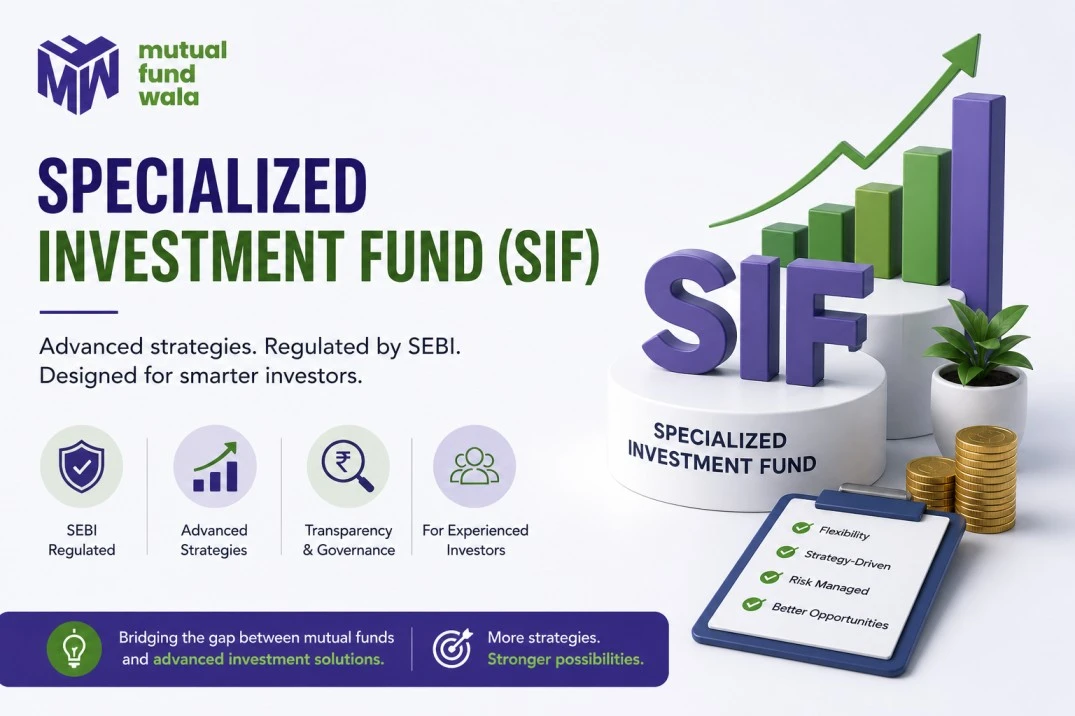
In essence, SIF India is creating a middle layer—an option for investors seeking strategy-driven returns without sacrificing the advantages of transparency, liquidity, and taxation associated with mutual funds.
Read More: What Is The Flexi Cap Mutual Fund?
How SIFs invest: Expanding the strategy toolkit
The real differentiation of a Specialized Investment Fund lies in how it invests.
Traditional mutual funds operate under relatively tight constraints regarding derivatives.
Their usage is largely limited to hedging or portfolio rebalancing.
SIFs, on the other hand, can take unhedged derivative positions (or naked shorts) up to 25% of their net asset value.
This single change expands the entire strategy landscape. A SIF fund can implement long-short strategies, where it takes long positions in expected outperformers while shorting potential underperformers.
The objective shifts from relative returns to more consistent, absolute return generation.
SEBI has also structured these funds into three broad categories: equity, debt, and hybrid. Each comes with clearly defined sub-strategies.
Equity-oriented strategies
Within equity, the flexibility is visible across three sub-categories.
Funds can operate as pure long-short strategies, focus on stocks beyond the top 100 by market capitalization, or take sector-specific positions through rotation strategies.
Despite this flexibility, risk controls remain intact. Exposure to a single company is capped at 10% of the portfolio, and leverage is not permitted. Even short exposure is capped, ensuring that SIF investment does not become excessively aggressive.
Liquidity also remains relatively high, with most equity strategies offering daily or near-daily redemption options.
Debt-oriented strategies
In debt, the SIF investment fund structure enables active positioning across interest-rate cycles and credit spreads.
Funds can take short positions using debt derivatives, enabling them to benefit from rising yields or hedge duration risks more effectively. Sector-specific debt strategies further allow concentration, albeit within defined limits to ensure diversification.
Interestingly, issuer limits are more relaxed than those of traditional mutual funds. This allows fund managers to take higher exposure to high-quality issuers when conviction is strong. However, liquidity is lower than that of equity, with redemptions typically allowed weekly.
Hybrid strategies
Hybrid SIFs bring together multiple asset classes within a single strategy. These funds can dynamically allocate across equity, debt, REITs, InvITs, and even commodities. They can also use advanced derivative strategies such as covered calls, arbitrage, or volatility-based trades. The objective here is not just diversification, but active risk management and return optimization.
Redemption frequency usually falls between equity and debt, often allowing withdrawals multiple times a week.
Taxation and structural advantages
One of the key reasons why SEBI Specialized Investment Funds stand out is taxation.
At the fund level, there is no tax liability under Section 10(23D), similar to mutual funds. This ensures that returns are not eroded within the structure itself.
At the investor level, taxation depends on the underlying asset mix.
Equity-oriented SIFs attract long-term capital gains tax of 12.5% (above gains of ₹1.25 lakh) after one year, while debt-oriented investments are taxed as per the investor’s income slab.
This structure makes SIF investment relatively more efficient compared to PMS, where taxation applies to every transaction, or AIFs, where tax treatment can be more complex.
Additionally, operational features such as Systematic Investment Plans (SIP), Systematic Withdrawal Plans (SWP), and Systematic Transfer Plans (STP) may be available, making these funds more flexible from a planning perspective.
Where SIF stands among MF, PMS, and AIF
To fully understand the positioning of a Specialized Investment Fund, it helps to compare it with existing options.
Mutual funds offer accessibility and simplicity but come with strategy limitations. PMS provides customization but requires a significantly higher investment and involves complex taxation. AIFs offer the highest flexibility but are designed primarily for ultra-HNIs.
The SIF fund effectively sits in between. It retains the regulatory comfort and tax efficiency of mutual funds while introducing strategy flexibility closer to PMS and AIFs. This positioning is a deliberate attempt by regulators to deepen the investment ecosystem without further fragmenting it.
The bigger picture
The introduction of SIF India is not just about a new product category. It reflects a broader shift in how investing is evolving. At Mutual Fund Wala, this shift is seen as a significant step toward more intelligent and flexible investing.
Investors today are more aware, more data-driven, and more willing to explore strategies beyond traditional long-only investing. At the same time, there is a clear preference for transparency, liquidity, and regulatory oversight—principles strongly aligned with the approach at Mutual Fund Wala.
By introducing the Specialized Investment Fund, SEBI is effectively acknowledging this shift. It is expanding the boundaries of mutual funds while ensuring that the core principles of investor protection, disclosure, and discipline remain intact.
For investors, this opens up a new layer of opportunity. In the end, the relevance lies in how effectively this structure bridges a long-standing gap in the investment landscape with guidance from Mutual Fund Wala.
FAQs
Like This Blog? Share With Others


 Shashi Kant Bahl