How flexi cap funds position themselves differently
To understand why this category stands out, it helps to look at how returns are driven.
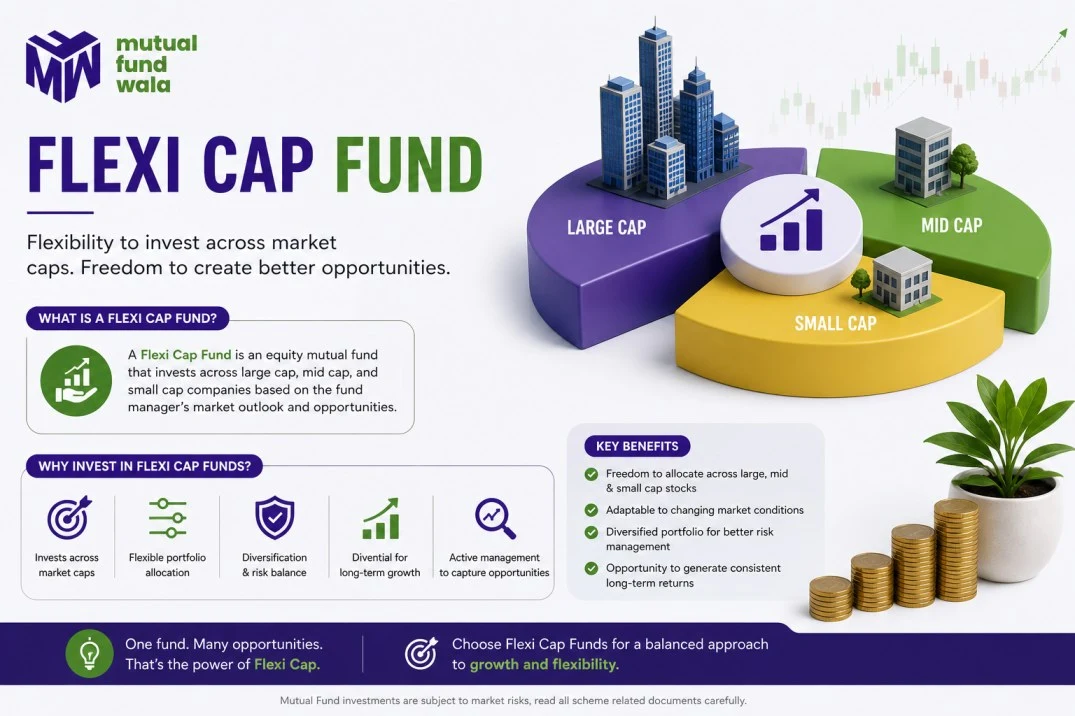
Most investors chase segments. For instance: large caps for stability, midcaps for growth, and small caps for higher risk-reward. But markets do not move in a straight line. Leadership rotates.
A flexi-cap fund attempts to capture this rotation.
Instead of the investor making allocation calls, the responsibility shifts to the fund manager.
This also explains why many investors searching for the best flexi cap mutual funds are not just looking at returns, but also consistency, portfolio construction, and how the fund has navigated different cycles.
How to identify the best flexi cap mutual funds
Choosing among the best flexi cap mutual funds requires going beyond recent returns.
Consistency becomes important. Funds that deliver stable returns across cycles tend to be more reliable than those driven by short-term rallies.
Portfolio allocation also matters. A fund that aggressively shifts its holdings may generate higher returns but also come with higher volatility.
The fund manager’s style plays a critical role.
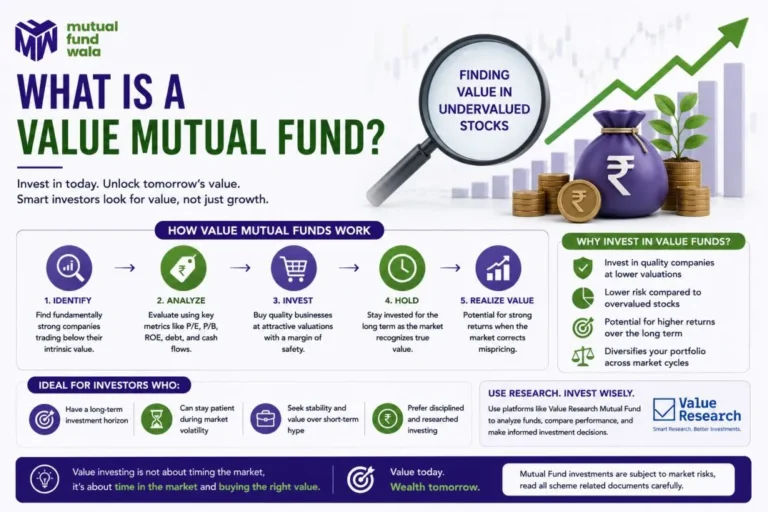
Some funds are valuation-driven, others are growth-oriented, and a few combine both approaches. Understanding this helps align the fund with your risk profile.
Expense ratios, turnover, and risk metrics such as drawdowns should also be evaluated, especially when comparing funds within the same category.
Read More: How to Calculate Mutual Fund Returns
Parag Parikh Flexi Cap
Parag Parikh Flexi Cap Fund has built a distinct identity within the flexi cap fund category, mainly due to its ability to invest in both Indian and global equities.
This adds a layer of diversification that most peers do not offer.
The fund follows a value-driven approach, focusing on businesses with steady cash flows and avoiding expensive growth bets. As of 31 March 2026, it had an AUM of ₹128,966 crore, with an expense ratio of 0.62% (direct plan).
Its allocation remains equity-heavy at 77.34%, followed by 13.37% in debt, 3.72% in real estate, and 5.57% in cash. The portfolio is largely tilted towards large caps (94.04%), with smaller exposure to small caps (3.48%) and mid caps (2.47%).
Despite its size, the fund holds a relatively concentrated portfolio of 43 stocks, with the top 10 accounting for 48.82%. Key holdings include HDFC Bank, Power Grid, Coal India, ICICI Bank, and ITC, as well as global names such as Alphabet, Meta, Amazon, and Microsoft.
On the risk side, the fund has shown lower volatility, with a standard deviation of 9.76 versus 14.63 for the benchmark. This reflects in its risk-adjusted performance as well, with a Sortino ratio of 1.41 and a Sharpe ratio of 1.08, both higher than the benchmark.
This disciplined approach has translated into returns, with the fund delivering a 10-year CAGR of 18.09%.
HDFC Flexi Cap Fund Growth
HDFC Flexi Cap Fund follows a value-oriented approach, focusing on companies trading below their intrinsic value and often taking contrarian positions.
The fund uses a bottom-up strategy to identify fundamentally strong businesses across market caps, with an emphasis on quality and reasonable valuations.
As of 31 March 2026, the fund’s AUM stood at ₹91,335 crore, with an expense ratio of 0.68% (direct plan). The portfolio remains heavily equity-focused at 93.06%, with 2.42% in real estate, 0.55% in debt, and 3.97% in cash to navigate market opportunities.
The fund holds 59 stocks, with the top 10 accounting for 47.42% of the portfolio. Its largest exposures include ICICI Bank, HDFC Bank, Axis Bank, SBI, and SBI Life Insurance. The low portfolio turnover ratio of 0.94% reflects a long-term, high-conviction investment approach.
This strategy has translated into a 10-year CAGR of 17.15%.
The fund has also maintained relatively lower volatility, with a standard deviation of 12.75 compared to 14.63 for the benchmark (BSE 500 TRI). Its Sharpe ratio stands at 0.91 versus 0.49 for the benchmark, while the Sortino ratio at 1.05 indicates better downside risk management.
For investors evaluating the best flexi cap mutual funds, HDFC’s and Parag Parikh offerings stand out for their long-term orientation and willingness to take differentiated calls.
Where flexi cap funds fit in a portfolio
A flexi cap fund can often act as a core equity allocation.
For investors who don’t want to actively track market segments, this category simplifies decision-making.
The fund manager takes the call on allocation, allowing the investor to stay invested across cycles.
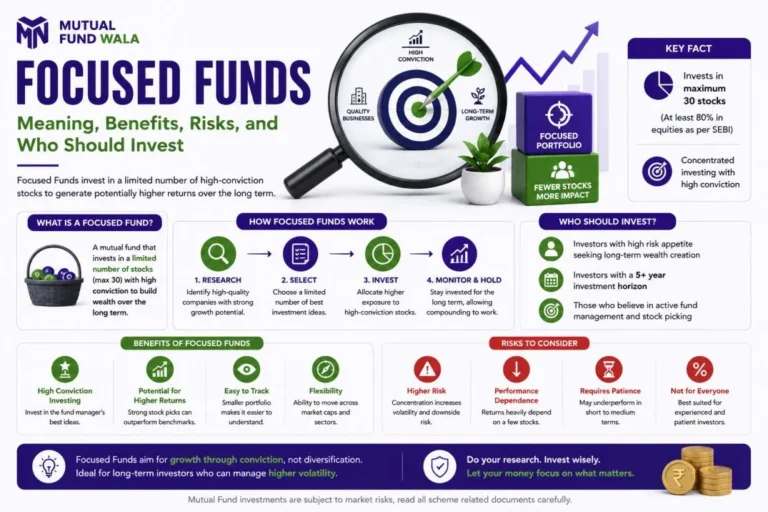
However, this does not mean they replace all other funds. Some investors still prefer to combine flexi-cap funds with focused strategies, such as mid-cap or sectoral funds, to generate additional alpha.
The key is to understand that flexibility does not eliminate risk. Rather, it redistributes it through active management.
Conclusion
The appeal of a flexi cap fund lies in its ability to adapt. In a market where leadership keeps shifting, rigid allocation strategies often fall short. At Mutual Fund Wala, this adaptability is seen as a key advantage for long-term investors.
By allowing fund managers to move across segments, this category offers a more dynamic approach to equity investing. Funds like ICICI Prudential, Kotak, HDFC, and Parag Parikh each interpret this flexibility differently through valuation discipline, quality focus, contrarian bets, or global diversification.
For investors, the choice is not just about selecting the best flexi-cap mutual funds, but also about understanding which investment style aligns with their expectations with guidance from Mutual Fund Wala.
FAQs
Like This Blog? Share With Others


 Shashi Kant Bahl