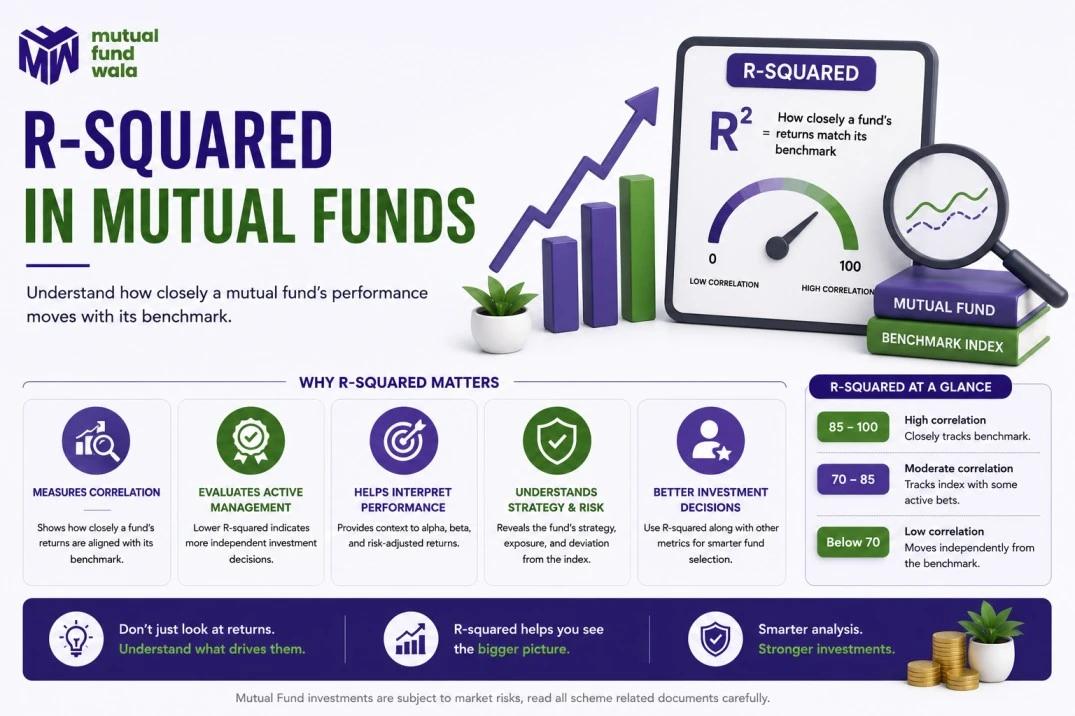
Understanding R-Squared Meaning in Mutual Funds With an Example
Let us take a practical example.
Suppose Raj invests in a large-cap mutual fund benchmarked against the Nifty 50.
After checking the fund factsheet, he notices:
- Fund A has an R-squared of 98
- Fund B has an R-squared of 72
What does this mean?
Fund A is behaving almost exactly like the Nifty 50. Its returns are highly dependent on index movements. Even if the fund manager changes stocks, the overall portfolio still behaves very close to the benchmark.
Fund B, however, is taking relatively different calls. The fund manager may be overweight on certain sectors, hold cash differently, or choose stocks outside the benchmark universe.
This is the practical R-squared meaning in mutual funds.
It helps investors understand whether the fund manager is actively managing money or simply hugging the benchmark.
Why is R-squared in Mutual Funds Important?
Most investors focus only on returns. But returns alone do not reveal how those returns were generated.
The R-squared ratio for a mutual fund is important because it provides context for performance.
Here is why it matters:
1. Helps Evaluate Active Fund Management
If a mutual fund has a very high R-squared, it means the fund is closely tracking the benchmark.
In such cases, investors may question whether paying a higher expense ratio for active management makes sense.
For example, if an actively managed large-cap fund has:
- R-squared of 99
- Expense ratio of 1.8%
Then investors may compare it with a low-cost index fund tracking the same benchmark.
2. Important for Interpreting Alpha and Beta
Metrics like alpha and beta become more meaningful when the R-squared in mutual funds is high.
Suppose a fund claims to have a high alpha. If the R-squared is very low, comparing alpha against the benchmark may not provide reliable insight, as the fund is not closely tied to it in the first place.
This is why analysts often use R-squared along with beta and alpha.
3. Helps Understand Portfolio Strategy
A lower R-squared may indicate:
- Higher active management
- Sector concentration
- Tactical allocation
- Off-benchmark exposure
This can increase both opportunity and risk.
A higher R-squared usually means:
- More benchmark alignment
- Lower deviation from the index
- More predictable relative performance
What Is a Good R-squared Ratio in a Mutual Fund?
There is no universally “good” number. It depends on the category and investment style.
Still, here is a broad understanding:
| R Squared Value | Interpretation | Investor Action / Insight |
| 85 to 100 | High correlation to benchmark | Ideal for Index funds/ETFs. For active funds, check if you are paying too much for “closet indexing.” |
| 70 to 85 | Moderate benchmark alignment | The manager tracks the index structure but takes selective, localized bets. |
| Below 70 | Low correlation to benchmark | The fund moves independently. Alpha/Beta figures against this benchmark are less reliable. |
For index funds and ETFs, a high R-squared ratio in a mutual fund is usually desirable because the goal is to track the benchmark closely.
For actively managed funds, the interpretation becomes more nuanced.
A lower R-squared does not necessarily indicate better performance. It simply means the fund manager is taking more independent calls. Those calls can either generate superior returns or increase risk.
How Investors Should Use R-Squared in Mutual Funds
Most retail investors should not use this metric in isolation. Instead, it should be part of a broader fund evaluation process.
Here is how investors can use it effectively.
Compare Similar Funds
If two funds belong to the same category but one has a significantly higher R-squared, it indicates different management styles.
For example:
- One fund may behave like an index
- Another may be more aggressive
This helps investors choose funds based on risk preference.
Use It Alongside Alpha and Beta
The R-squared meaning in mutual funds becomes more useful when combined with:
- Alpha
- Beta
- Standard deviation
- Sharpe ratio
A high alpha with a high R-squared often indicates genuine outperformance relative to the benchmark.
Avoid Blind Dependence
A low R-squared does not guarantee better returns.
Many investors wrongly assume that a fund taking independent calls will automatically outperform. In reality, excessive deviation from the benchmark can also increase volatility and downside risk.
Difference Between Beta and R-Squared in Mutual Funds
Investors often confuse beta with R-squared.
Here is the simple difference.
- Beta measures the magnitude of a fund’s reaction to its benchmark (how far it jumps when the benchmark moves).
- R-Squared measures the reliability of that relationship (how consistently it jumps in tandem with the benchmark).
For example:
- A beta of 1.2 means the fund is historically 20% more volatile than its benchmark.
- An R-squared of 95 means 95% of that fund’s price movements are directly explained by the benchmark’s movements.
Both metrics serve different purposes but work best together. Think of Beta as the speed of the car, and R-squared as how closely it follows the GPS route
Should Beginners Focus on R-squared in Mutual Funds?
For beginners, this metric is useful but should not become the primary decision-making factor.
A new investor should first focus on:
- Asset allocation
- Investment horizon
- SIP discipline
- Fund category selection
- Consistency of returns
Once these basics are covered, understanding metrics such as the R-squared ratio for a mutual fund can help refine portfolio decisions.
Think of R-squared as an advanced diagnostic tool rather than a starting point.
Conclusion
Understanding R-squared in mutual funds can help investors move beyond surface-level return comparisons and evaluate how a fund truly behaves.
The metric reveals whether a fund manager is closely following the benchmark or taking independent investment calls. It also helps investors interpret other important measures, such as alpha and beta, more accurately.
However, investors should avoid relying on R-squared alone when selecting funds. A mutual fund should always be evaluated based on portfolio quality, consistency, risk metrics, expense ratio, and long-term suitability.
For long-term wealth creation, discipline and asset allocation still matter far more than chasing technical indicators. But understanding the R-squared metric in mutual funds can help investors become more informed and confident as they build their portfolios.
FAQs
Like This Blog? Share With Others


 Shashi Kant Bahl