One of the biggest questions investors face while starting their mutual fund journey is whether to invest in large-cap, mid-cap, or small-cap funds. A quick internet search often yields terms like large-cap vs mid-cap vs small-cap, but understanding the real differences can be confusing.
Should a 25-year-old invest aggressively in small caps? Is a 45-year-old better off with large caps? Does age alone decide the right mutual fund category?
The answer is no.
Age is certainly an important factor, but your financial goals, risk appetite, and investment horizon also play an equally important role. Choosing the right category is not about finding the “best” fund. It is about finding the fund that matches your stage of life.
Let’s understand the difference between small-cap, mid-cap, and large-cap stocks in simple language and see which category may suit investors at different ages.
What are Large Cap, Mid Cap, and Small Cap?
Before comparing large-cap, mid-cap, and small-cap, it is important to understand market capitalisation in mutual funds.
Market capitalisation, or market cap, is the total value of a company’s outstanding shares. Based on market capitalisation, listed companies are classified into large-cap, mid-cap, and small-cap segments.
According to the SEBI classification of mutual funds, companies are broadly divided into:
- Large-cap companies: Top 100 companies by market capitalisation.
- Mid-cap companies: Companies ranked from 101 to 250.
- Small-cap companies: Companies ranked 251 and beyond.
This SEBI classification ensures that funds remain consistent in their investment strategies, allowing investors to know exactly where their money is going.
What Is Large Cap and Small Cap?
Many beginners search for what large-cap and small-cap stocks are before investing.
Large-cap companies are established businesses with proven track records, stable earnings, and strong market presence. They are generally industry leaders with relatively lower volatility.
Small-cap companies are much smaller businesses with significant growth potential. Since they are still expanding, they can generate impressive long-term returns, but they also experience sharper price fluctuations.
Mid-cap companies sit between these two categories. They are usually growing businesses that have moved beyond the startup stage but still have room for expansion.
Difference Between Small Cap, Mid Cap, and Large Cap
Understanding the difference between small-cap, mid-cap, and large-cap becomes easier through a comparison.
| Feature | Large Cap | Mid Cap | Small Cap |
|---|
| Company Size | Largest companies | Medium-sized companies | Smaller companies |
| Risk | Lower | Moderate | Higher |
| Return Potential | Moderate | High | Highest, but uncertain |
| Volatility | Relatively low | Moderate | High |
| Suitable Investment Horizon | 5 years or more | 7 years or more | 10 years or more |
This comparison shows that every category serves a different purpose in an investment portfolio.
Large Cap vs Mid Cap
The debate around large-cap vs. mid-cap often comes down to balancing stability and growth.
A large-cap fund primarily invests in established companies. These businesses generally have stable earnings and stronger balance sheets, making them relatively less volatile during market corrections. This is why the stability of large-cap funds is often appreciated by conservative investors.
Mid-cap funds, on the other hand, invest in companies that are still growing rapidly. While they offer higher growth potential, they also experience greater volatility during market cycles.
For investors seeking a balance between risk and return, mid-caps may provide higher long-term growth than large caps, provided they are willing to stay invested for several years.
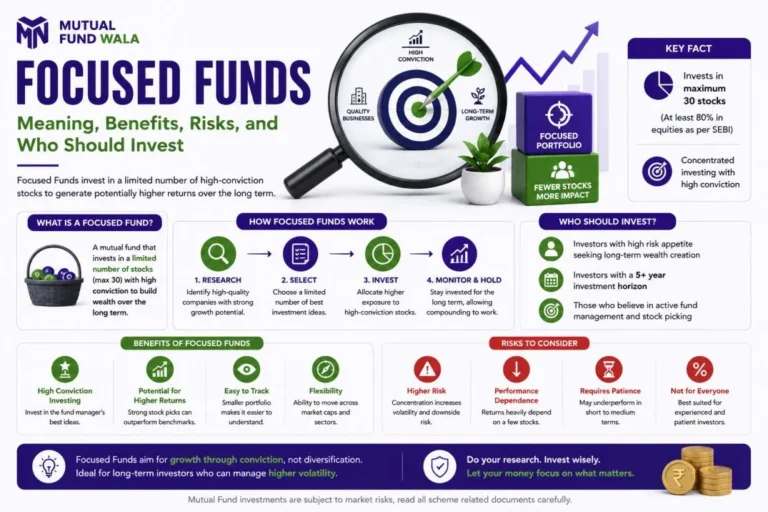
Also Read: Focused Funds Explained: Meaning, Benefits, Risks, and Who Should Invest
Large Cap vs Small Cap
When comparing large-cap vs. small-cap, the difference becomes even more noticeable.
Large-cap funds usually provide relatively stable returns because they invest in established businesses. These companies often have diversified operations and are better equipped to handle economic slowdowns.
Small-cap funds follow a completely different path. Their portfolio consists of emerging companies that can grow significantly over time. This explains why investors often associate small-cap funds with high risk and high return in this category.
However, higher return potential always comes with greater volatility. During market downturns, small-cap funds may witness much steeper declines than large-cap funds.
Small Cap vs Mid Cap vs Large Cap
The comparison of small-, mid-, and large-cap stocks is not about identifying a winner. Instead, it is about matching investments with financial goals.
Large-cap funds focus on stability.
Mid-cap funds focus on balancing growth with moderate risk.
Small-cap funds focus on maximizing long-term growth while accepting higher volatility.
Most experienced investors diversify across all three categories rather than depending entirely on one.
Which Fund Is Right for Your Age?
Investors in Their 20s
Investors in their twenties usually have the longest investment horizon.
Since retirement and major financial goals may still be decades away, they can generally tolerate short-term market volatility better. This allows greater exposure to mid-cap and small-cap funds, while maintaining some allocation to large caps for stability.
For many young investors, a disciplined SIP across different age groups can help manage market volatility over time.
Investors in Their 30s
During this stage, responsibilities such as home purchases, children’s education, and family expenses often begin increasing.
A balanced allocation across large-cap, mid-cap, and small-cap funds may work well. This allows investors to continue participating in long-term growth while gradually improving portfolio stability.
Investors in Their 40s
Investors entering their forties generally start focusing more seriously on wealth preservation alongside growth.
Increasing exposure to large-cap funds while maintaining selective allocation to mid-caps can help reduce overall portfolio volatility without completely sacrificing long-term growth.
Investors Above 50
As retirement approaches, protecting accumulated wealth becomes increasingly important.
At this stage, portfolios often shift toward large-cap funds because of their relatively stable nature. Limited exposure to mid-caps may still support inflation-beating returns, while excessive allocation to small caps may not suit every investor. As you approach 60, fixed-income investments like bonds can become a significant part of your portfolio.
Should Age Alone Decide Your Investment?
While this article focuses on large-cap vs mid-cap vs small-cap, age should never be the only deciding factor.
Two investors of the same age can have completely different financial situations.
For example, a 30-year-old saving for retirement over the next 30 years may comfortably invest in small caps. Another 30-year-old planning to buy a house within three years may need a much more conservative portfolio.
Your equity mutual fund risk profile, financial goals, emergency savings, and investment horizon matter just as much as your age. Also, your risk appetite and financial goals must always take precedence over age-based rules of thumb.
Conclusion
Understanding large-cap, mid-cap, and small-cap is one of the first steps towards building a strong mutual fund portfolio. At MutualFundWala, we believe that informed investment decisions are the foundation of long-term financial success.
Large-cap funds provide stability, mid-cap funds offer balanced growth, and small-cap funds aim for higher long-term returns while carrying greater risk. None of these categories is universally better than the others. The right choice depends on your age, financial goals, risk tolerance, and investment horizon.
Instead of trying to predict which category will perform best every year, investors should focus on building a diversified portfolio that evolves as their financial needs change. A disciplined SIP and long-term investing approach often matters far more than selecting a single winning category. MutualFundWala helps investors choose the right mix of mutual funds based on their unique financial goals, ensuring a balanced and well-planned investment journey.
FAQs
Like This Blog? Share With Others


 Shashi Kant Bahl