

 Shashi Kant Bahl
Child Education Calculator
Planning for your child’s education starts with knowing how much you may need in the future. The Child Education Plan Calculator helps estimate future education costs based on inflation, your investment horizon, and expected returns, so you can understand the corpus you may need to work towards your child’s higher education goals.
Future Education Cost
Education Inflation
Education Corpus
Education Planner
Estimate your child's future higher education cost and the monthly SIP that could help you plan for it.
Your Education Planning Estimate
Annual cost: today vs. first year of college
Estimate Your Child's Future Education Costs
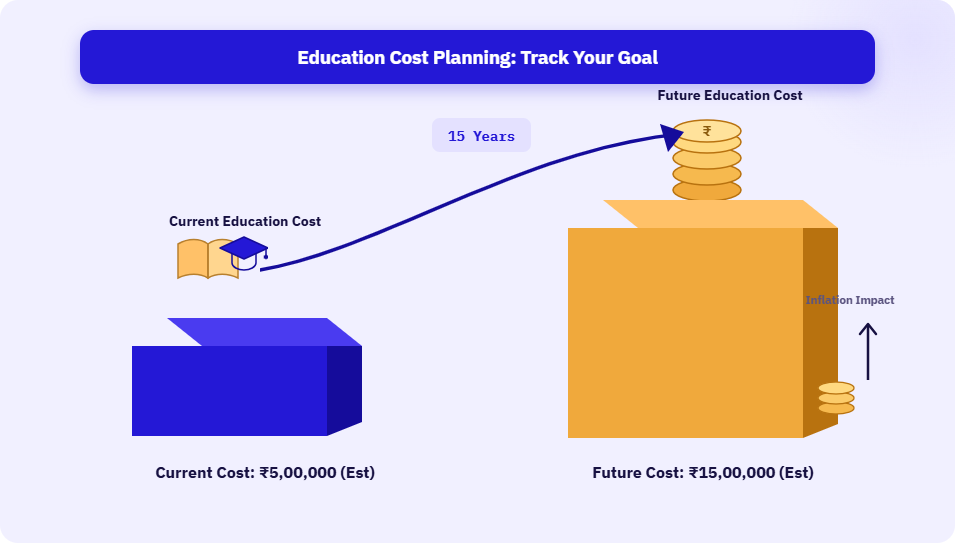
Education costs can rise significantly over time, making early goal-based planning important.
The Child Education Plan Calculator helps you estimate future education costs based on factors such as your child’s age, current education costs, inflation, investment horizon, and expected returns. It can help you understand the education corpus you may need for your child’s future goal.
What This Child Education Calculator Does
The calculator works backwards from your education goal. It helps you:
- Project the future cost of your child's education by applying education inflation to today's cost
- Estimate the corpus you'll need when college begins
- Calculate the monthly SIP or lump sum that could help you reach it
You can use it for graduation, post-graduation, or overseas studies.
How to use Child Education Investment Plan Calculator
- Enter your child's current age and the age at which college is expected to start.
- Enter how many years the course will run.
- Enter today's annual cost of the course.
- Choose an education inflation rate. It is usually higher than general inflation.
- Enter your assumed annual return.
The calculator shows the future cost, the corpus needed at college start, and the lump sum or monthly SIP that could help you get there.
When This Calculator Is Useful
- Parents preparing for their children’s future education expenses. Individuals building towards long-term financial goals such as retirement, education, or wealth creation.
- Parents of teenagers planning for college or overseas studies.
- Anyone who wants to see if their current investments are enough for future education costs.
The numbers are estimates based on your inputs for inflation and returns. Education costs may vary by city, country, and course. Review your investment for child education plan regularly and adjust as needed.
What is an Education Planner and How It Helps
An education planner is designed to estimate the cost of your child’s future education and map out how to achieve it.
With an education planner, you can project what a course may cost in the future and how much you may need to invest today. It is often the first step in turning a broad goal into a defined financial plan.
How Rising Costs Affect Your Education Goal.
Education costs can increase significantly over time, making early planning important.
The Calculator helps estimate how education expenses may change with inflation and how much you may need to invest based on your time horizon and expected returns. For example, a degree costing ₹10 lakh today could cost considerably more in 12 to 15 years.
Understanding these potential costs early can help you set a realistic education goal and plan your investments accordingly.
| Course | Approx. Current Cost in India |
|---|---|
| Engineering (Private) | ₹8–15 lakh |
| MBBS (Private) | ₹50 lakh–₹1 crore |
| MBA (Top B-Schools) | ₹20–25 lakh |
| Study Abroad (Undergraduate) | ₹40 lakh–₹1 crore+ |
Costs vary significantly by institution, city, country, and course specialization. These figures are indicative and should be used only as a starting reference.
From Future Cost to Monthly Investment
Once the future cost is known, the next step is to determine how much to invest regularly.
A child education plan calculator helps calculate the monthly or yearly investment required to reach your goal. This turns planning into action.
Instead of saving arbitrarily, you align your investments with a specific target, making your child’s education plan more disciplined.
Choosing the Right Child Education Investment Plan
A child education investment plan depends largely on the time available before the education goal and your financial circumstances.
For longer-term goals, investors may consider different types of mutual funds based on their investment horizon and risk tolerance. For shorter-term goals, investors may also consider options with lower exposure to market fluctuations.
An education investment plan should be aligned with the goal’s timeline, expected expenses, and your financial capacity.
Mutual Funds vs. Sukanya Samriddhi Yojana (SSY)
Parents planning for a girl child’s education may consider different savings and investment options, including the Sukanya Samriddhi Yojana (SSY) and mutual funds.
SSY is a government-backed small savings scheme available for eligible girl children, with an interest rate notified by the government and tax benefits subject to applicable rules. Mutual funds are market-linked investments available across different categories, with flexibility in investment amounts and timing.
The two options have different features, eligibility requirements, return structures, risks, and withdrawal rules. Understanding these differences can help parents evaluate how each option may fit their education goal, investment horizon, and financial circumstances.
Investment in Child Education Requires Consistency
When it comes to investment for child education, consistency plays a bigger role than timing.
Regular investments through SIPs help build the required corpus over time. This is where tools like a child plan calculator or even a simple child calculator can help track whether you are on the right path.
Small, consistent investments can grow into a meaningful corpus over time.
Child Insurance Plan Calculator: Should You Consider It
Some investors explore insurance-linked options to achieve educational goals.
A child insurance plan calculator helps estimate returns from such plans. However, it is important to evaluate them carefully, as returns are often lower than those of market-linked instruments.
Separating insurance and investment usually offers more flexibility and transparency.
Building a Kids Education Plan That Adapts Over Time
A kid’s education plan should not remain static.
As your income grows, you can increase contributions. As the goal approaches, shifting towards lower-risk instruments helps protect the accumulated corpus.
This gradual transition ensures that your plan remains aligned with both market conditions and your financial situation.
Avoiding Common Mistakes in Education Planning
One of the most common mistakes is underestimating costs. Another is delaying investments.
An education planner helps avoid both by providing a structured approach. It ensures that you start early and stay consistent.
It also reduces reliance on loans, which can create financial pressure later.
Final Thought
Your child’s education is one of the most important goals you’ll plan for, and the earlier you estimate it, the more time you have to prepare. Use this education planner to test a few scenarios, such as a different college, a longer course, or a later start, and see how the numbers change. If you’d like help turning the estimate into a plan, the MutualFundWala team is here to support you.
Popular Calculators
How to use Child Education Investment Plan Calculator
Enter Five simple inputs to estimate the education goal and investment requirement.

Enter your child’s current age
Start with the child’s age today.

Set the college start age
Choose when the higher education goal is expected to begin.

Add the college duration
Enter the number of years the course is expected to run.

Enter current annual college cost
Use the current cost of the course or target education expense.

Choose inflation and expected return
Use your assumptions to project future education costs and required savings.
FAQs – Education Planner
What is an education planner?
An education planner helps estimate your child’s future education costs and how much you may need to invest based on the goal, time horizon, inflation, and expected returns.
How does a child education calculator work?
A child education calculator estimates the future cost of education by considering the current cost, years until college, expected inflation, and expected investment returns.
What investment options can I consider for my child's education?
Parents can consider different savings and investment options, including mutual funds and government-backed schemes such as Sukanya Samriddhi Yojana, depending on eligibility, time horizon, risk tolerance, and financial circumstance
How does inflation affect my child's education goal?
Higher education costs can increase over time due to inflation. The calculator applies an assumed education inflation rate to estimate what the current cost may become when your child starts college.
Should I use SIP or lump sum for my child's education goal?
SIP involves investing a fixed amount at regular intervals, while a lump sum involves investing a larger amount at one time. The choice depends on your available funds, investment horizon, and financial circumstances.
How can I start planning for my child's education?
Start by estimating the current education cost, deciding when the funds will be needed, and accounting for future cost increases. You can then use the calculator to estimate the investment requirement for the goal.
When should I start investing for my child's education?
Starting early gives you a longer investment period to work towards the education goal. It can also allow the required investment to be spread over a longer period.
Ready to Secure Your Child's Higher Education?
Estimate your future education needs and take the next step towards managing your mutual fund investments with the MutualFundWala App.


Get Education Planning Help
A calculator gives you an estimate. A structured plan helps you stay on track. Share a few details to get help with your child’s education goal.
- Goal-based education planning
- Support in aligning investments with your time horizon
- No obligation — just a clearer plan