

 Shashi Kant Bahl
The daily SIP vs monthly SIP debate comes up often: does putting in a small amount every day help you earn better returns than investing once a month? If you are new to SIPs, read our guide on what is SIP in mutual funds before comparing frequencies. A daily SIP gives you more investment dates and spreads your money across different market levels. But does investing more frequently actually help you build a larger corpus?
Not necessarily. Daily SIPs do not automatically deliver higher returns than monthly SIPs. When the total amount invested, investment period and mutual fund remain the same, the outcome can differ because the two approaches buy units on different dates and at different prices.
So, in the daily SIP vs monthly SIP comparison, which works better over the long term? Let’s look at the numbers and see what the data tells us.
Daily SIP vs Monthly SIP: What Is the Difference?
A daily SIP invests a small amount on each market day, while a monthly SIP invests a larger amount once a month. Over a month, both allocate roughly the same capital, but daily SIPs spread execution across approximately 20-22 trading days per month.
For example, instead of investing ₹6,000 once a month, an investor could invest roughly ₹300 a day (assuming 20 trading days in that month). Both approaches can put a similar amount into the same mutual fund over time.
With a monthly SIP, you might invest the entire ₹6,000 on the 10th of every month. With a daily SIP, the same monthly amount could be divided across the market days of the month. That means your money enters the market at different points. ‘Rupee cost averaging‘ occurs more frequently in a daily SIP compared to a monthly SIP.
If the market falls after your monthly SIP date, a daily SIP may have some instalments going in at lower prices. Likewise, a monthly SIP can benefit when markets rise after the start of the month because more money gets invested earlier. This is the part that often gets missed in the daily SIP vs monthly SIP returns debate.
| Particulars | Daily SIP | Monthly SIP |
|---|---|---|
| Investment Frequency | Every trading day (20–22 times/month) | Once per month (12 times/year) |
| Investment Amount | Smaller instalments | Larger instalment |
| Bank Entries per Year | Around 240–250 a year | 12 a year |
| Market Exposure | Spread across the month | Concentrated around the SIP date |
| Cash-Flow Convenience | Requires sufficient balance for frequent debits | Easier to align with monthly income |
| Rupee-Cost Averaging | Purchases spread across more dates | Purchases concentrated on one date |
| Does It Guarantee Higher Returns? | No | No |
| Suitable For | Daily earners and investors with irregular cash flows who prefer smaller, more frequent investments | Most investors, including salaried employees with recurring monthly paychecks |
So, the frequency itself is not what creates wealth. The amount invested, time invested, and return generated by the underlying fund matter far more.
Does Daily SIP Give Higher Returns?
- To determine whether daily SIP vs monthly SIP XIRR is higher, we compared daily and monthly SIPs. Funds were invested in the Nifty 50 index over 15 years ending December 1, 2025. SIP Instalment amounts have been selected in such a way that the total investment remains the same across both frequencies.
In the daily SIP, ₹1,000 was invested on each trading day, resulting in 3,719 instalments over the investment period. In the monthly SIP, ₹20,547 was invested every month, resulting in 181 instalments. Regardless of the frequency, the total investment amount remained the same (₹37.19 lakh).
| SIP Frequency | Daily SIP | Monthly SIP |
|---|---|---|
| SIP Instalment Amount | ₹1,000 | ₹20,547 |
| Total No. of Instalments | 3,719 | 181 |
| Total Amount Invested | ₹37.19 lakh | ₹37.19 lakh |
| Valuation as of December 23, 2025 | ₹1.15 crore | ₹1.14 crore |
| XIRR* | 13.83% | 13.80% |
| Investment Universe | Nifty 50 | Nifty 50 |
XIRR have been calculated for SIP investments from December 1 2010 to December 1 2025. Source: Moneycontrol
So, does a daily SIP give higher returns? In this comparison, yes. But the difference is marginal. By December 23, 2025, the daily SIP had grown to ₹1.15 crore, with an XIRR of 13.83%. In contrast, the monthly SIP yielded a slightly lower corpus (₹1.14 crore) with an XIRR of 13.8%.
In simple terms, the investor made many more investments with the daily SIP, but that did not translate into significantly higher wealth. Both approaches generated broadly similar returns in this comparison, even though the investments were made on different dates. The effective difference came down to the prices at which units were purchased. But over the 15-year period, that impact was relatively small.
This is because, across both frequencies, SIPs remained invested through market fluctuations, including rallies, downturns and recoveries. Thus, the data suggests that consistency and staying invested matter much more than whether the SIP is made daily or monthly.
What about returns for Daily SIP vs Monthly SIP?
Another study spanning 30 years (August 1996 to June 2026) on the BSE Sensex Total Return Index by WhiteOak Capital Mutual Fund showed higher returns for a monthly SIP. WhiteOak’s analysis spanned SIP investments made between August 1996 and June 2026. The total amount invested remained the same across the three frequencies.
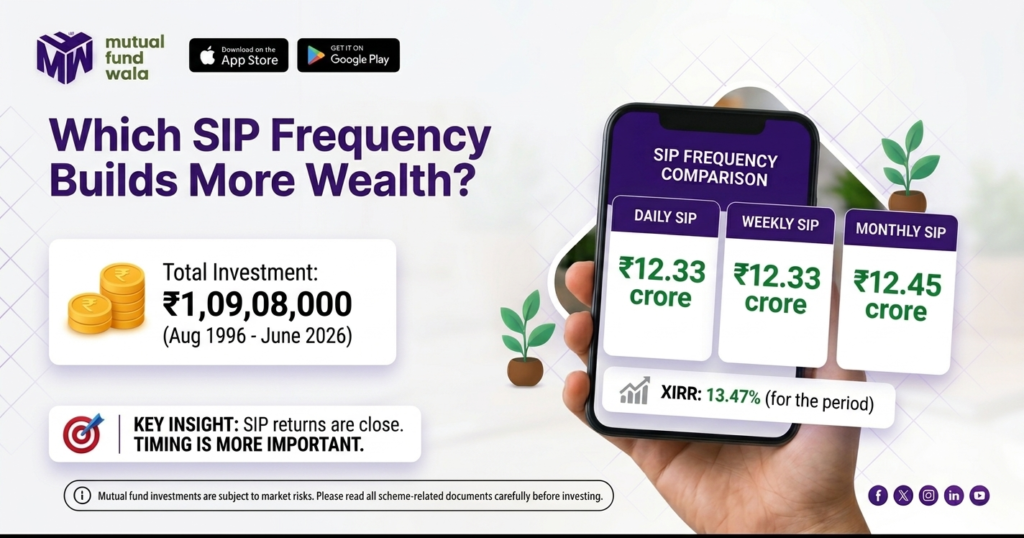
The analysis found that daily, weekly and monthly SIPs generated returns at 13.47% XIRR. However, the monthly SIP generated a higher corpus of ₹12.45 crore compared with ₹12.33 crore for the daily SIP and weekly SIP. Effectively, the difference is not significant because, in the long run, the impact of market fluctuations evens out.
Is a daily SIP good for the long term?
Daily SIP can be suitable for long-term investing, but there is no need to choose it solely because you expect higher returns. It also comes with a few extra hassles, such as daily transaction alerts, 245-250 debit entries in your bank account, and the need to maintain sufficient balance for each debit.
In the daily SIP vs monthly SIP decision, a monthly SIP simply makes more sense for most investors:
- It aligns with the monthly income cycles
- It’s relatively easier to track and manage than a daily SIP
- Keeping track of frequent instalments in a daily SIP can be a hassle
Monthly SIP frequency for salaried investors also works perfectly as it aligns with the monthly income cycle and makes it easier to invest a fixed amount consistently. Use our SIP calculator to estimate how your monthly contributions could grow over time. At the end of the day, staying consistent, disciplined investing and remaining invested through the period determines the final corpus.
Conclusion
Daily investing can spread purchases across daily market volatility, but it can also mean hundreds of additional bank debits without materially changing the outcome. The evidence shows that neither frequency has a consistent long-term edge. For someone earning a monthly salary, a monthly SIP is perfectly fine.
You don’t need to invest every day just to build wealth. It is easier to manage, fits naturally with your income cycle, and the return difference is unlikely to make a meaningful difference in your final corpus. What matters more is how much you invest, how long you stay invested, and whether you increase your investment as your income grows through a step-up SIP
Frequently Answered Questions
Is a daily SIP better than a monthly SIP?
Not necessarily. A daily SIP can deliver slightly higher returns in some periods, but the difference is usually small. In the 15-year Nifty 50 comparison above, the daily SIP generated an XIRR of 13.83%, compared with 13.80% for the monthly SIP. So, the frequency of investing alone does not make a major difference to long-term wealth.
Is a monthly SIP better for salaried investors?
For most salaried investors, a monthly SIP is more convenient. It can be timed around the monthly salary cycle and requires only 12 instalments a year. A daily SIP means more frequent debits and requires you to maintain sufficient bank balance for each instalment. If the return difference is marginal, the simpler option can make more sense
If the return difference is so small, what should investors focus on instead?
The bigger factors are how much you invest, how long you stay invested and whether you increase your investment as your income grows.
Does investing more frequently actually improve rupee-cost averaging?
It can make the averaging process more frequent, but that does not necessarily mean better returns. A daily SIP buys more frequently than a monthly SIP, but the total amount invested is still the same. Over a long period, the difference in the average purchase price can become quite small. This is why the 30-year WhiteOak study found that the daily, weekly, and monthly SIPs all generated 13.47% XIRR.
Why was the daily SIP corpus only slightly higher despite having 3,719 instalments?
Over a 15-year period, both strategies experienced the same broad market cycles. Some daily instalments benefited from lower prices, while others were invested when markets were higher. These differences largely offset each other over time.