
 Gaurav
Why SIP Makes Sense for Middle-Class Families in Delhi
Delhi is one of the most expensive cities in India to raise a family. Rent in areas like Dwarka, Rohini, and Noida has jumped 20–30% in the last three years. School fees at even mid-range private schools now cross ₹1 lakh per year. Vegetables, milk, petrol, metro fares everything costs more than it did just two years ago.
If you are a salaried professional earning ₹25,000–₹80,000 per month, or a small business owner in Laxmi Nagar, Karol Bagh, or Chandni Chowk, you already know this: your salary goes up by 5–8% a year, but your expenses go up by 10–12%. The gap between earning and needing keeps growing.
This is exactly why SIP investment in Delhi has exploded: lakhs of Delhi-NCR families have turned to SIP Systematic Investment Plan as their primary way of building wealth. SIP is not a product for rich people. It is a simple, automatic way for anyone a teacher, a shopkeeper, a delivery executive, a homemaker to invest a small fixed amount every month into mutual funds and let that money grow over time.
According to AMFI data, Delhi-NCR now has one of the highest per-capita mutual fund AUMs in India. Monthly SIP contributions across the country crossed ₹31,000 crore in 2026, and Delhi is among the top contributing cities. The reason is simple: people here understand that keeping money in a savings account at 3–4% interest is actually losing money when inflation runs at 6–7%.
If your savings are sitting in a bank account, a post office RD, or under the mattress SIP is the step you need to take today. And MutualFundWala is here to help you take that step, right here in Delhi.
New to SIP? Here is What You Need to Know
SIP (Systematic Investment Plan) is a method of investing a fixed amount every month into a mutual fund automatically, from your bank account. It uses two powerful forces: rupee cost averaging (buying more units when prices are low) and compounding (your returns earning their own returns). You can start a SIP from as low as ₹100/month, stop or pause anytime without penalty, and your money is always in your name with the AMC, not with any distributor.
We have written detailed guides on SIPs; read the one that fits your question:
SIP vs FD vs RD vs Gold vs LIC — An Honest Comparison
Most middle-class families in Delhi put their savings in Fixed Deposits, Recurring Deposits, LIC endowment plans, or buy gold. These feel safe because our parents did the same thing. But are they actually growing your money? If you are considering an SIP investment in Delhi, this honest comparison will help you decide.
| Investment Option | Monthly Amount | Duration | Approximate Annual Return | Total Invested | Approximate Value After 15 Years |
|---|---|---|---|---|---|
| Bank RD (Recurring Deposit) | ₹5,000 | 15 years | 6.5–7% | ₹9,00,000 | ₹14–15 lakh |
| Post Office RD | ₹5,000 | 15 years | 6.7% | ₹9,00,000 | ₹14.5 lakh |
| LIC Endowment Plan | ₹5,000 | 15 years | 4–5% (effective) | ₹9,00,000 | ₹11–13 lakh |
| Gold (Physical / Digital) | ₹5,000 | 15 years | 8–10% (historical) | ₹9,00,000 | ₹17–20 lakh |
| Equity Mutual Fund SIP | ₹5,000 | 15 years | 12–14% (historical average) | ₹9,00,000 | ₹25–30 lakh |
Note: Returns are illustrative based on historical averages. Mutual fund investments are subject to market risks. Past performance does not guarantee future results. Read all scheme-related documents carefully.
How Much SIP Do You Need? Delhi Life-Goal Planner
Every family in Delhi has financial goals. The problem is that most people don’t know how much they need to save each month to reach those goals. We have mapped common Delhi family goals to the SIP amounts needed so you can see exactly where you stand.
SIP Needed for Common Delhi Family Goals (at 12% Expected Annual Return)
| Life Goal | Today's Cost (2026) | Future Cost (with 7% inflation) | Time Horizon | Monthly SIP Needed |
|---|---|---|---|---|
| Child's B.Tech / Engineering College | ₹12–20 lakh | ₹24–40 lakh (in 10 years) | 10 years | ₹10,000–₹17,000 |
| Child's Medical College (Private) | ₹50 lakh–₹1 crore | ₹1–2 crore (in 10 years) | 10 years | ₹43,000–₹86,000 |
| Son's / Daughter's Wedding | ₹10–25 lakh | ₹25–60 lakh (in 15 years) | 15 years | ₹5,000–₹12,000 |
| Down Payment for 2BHK (Noida/Ghaziabad) | ₹15–25 lakh | ₹25–40 lakh (in 8 years) | 8 years | ₹16,000–₹26,000 |
| Down Payment for 2BHK (Dwarka/Rohini) | ₹25–40 lakh | ₹40–65 lakh (in 10 years) | 10 years | ₹17,000–₹28,000 |
| Retirement Corpus (₹40,000/month lifestyle) | ₹1.5–2 crore | ₹3–4 crore (in 25 years) | 25 years | ₹16,000–₹22,000 |
| Emergency Fund | ₹3–5 lakh | Same (invest in liquid funds) | 1–2 years | ₹15,000–₹22,000 |
| First Car (Maruti/Hyundai segment) | ₹7–12 lakh | ₹10–16 lakh (in 5 years) | 5 years | ₹12,000–₹20,000 |
| Dream Vacation (International Family Trip) | ₹3–5 lakh | ₹4–6 lakh (in 3 years) | 3 years | ₹10,000–₹15,000 |
Note: These are approximate illustrations assuming 12% annual returns for equity SIPs and 7% annual inflation. Actual returns may vary. Mutual fund investments are subject to market risks.
Want to Supercharge Your SIP?
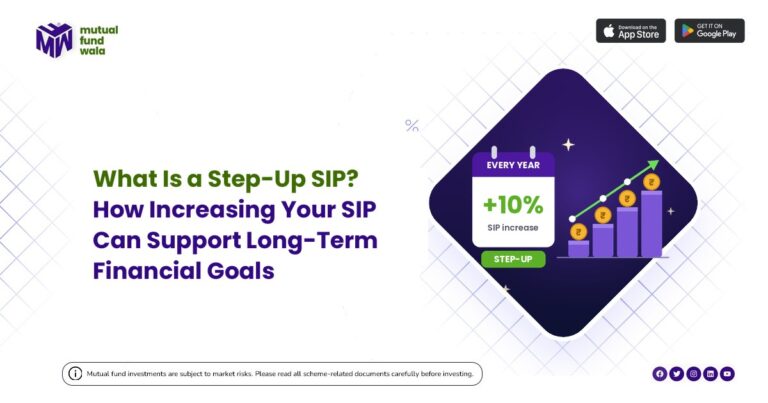
Once you have started a regular SIP, there are ways to accelerate your wealth building. A Step-Up SIP automatically increases your monthly amount every year — matching your salary growth. An STP lets you gradually move a lump sum into equity funds.
Read our detailed guides: What is Step-Up SIP? | STP vs SIP — Differences Explained
How to Start Your First SIP with MutualFundWala — 5 Simple Steps
Starting a SIP is easier than opening a bank account. Here is exactly what you need to do.
Step 1: Contact MutualFundWala
Call us, WhatsApp us, or fill out the form on this page. Tell us your name and that you want to start a SIP. One of our team members will call you back within a few hours. We speak Hindi and English whatever is comfortable for you.
Step 2: Complete Your KYC (One-Time Process)
KYC stands for Know Your Customer. It is a one-time process required by SEBI for all mutual fund investments. You need:
- PAN Card(mandatory)
- Aadhaar Card(linked to your mobile number for OTP verification)
- Bank account details(a cancelled cheque or bank statement)
- A selfie / passport-size photo
We help you complete the entire KYC process online. It takes about 10 minutes. You do not need to visit any office or submit physical documents.
Step 3: Choose Your Goals and Funds
This is where MutualFundWala adds value. We do not just give you a random fund name. We sit with you (on a call, video call, or in person) and understand:
- What are your financial goals? (Child education, home, retirement, etc.)
- What is your monthly income and how much can you comfortably invest?
- What is your risk comfort level? (Can you handle short-term market drops?)
- What is your time horizon for each goal?
Based on this, we recommend a portfolio of 2–4 funds matched to your goals. Every recommendation is based on your situation, not a generic list.
Step 4: Set Up Auto-Debit and Start
We help you set up an auto-debit mandate from your bank account. Your SIP amount is automatically deducted every month on the date you choose; no manual transfers needed. From first call to first SIP running: typically 2–3 working days.
We proactively reach out every 3–6 months for portfolio reviews. If a fund underperforms, we suggest alternatives. If your income grows, we suggest increasing your SIP.
Save Up to ₹46,800 in Tax Every Year with ELSS SIP

Why Choose MutualFundWala as Your SIP Distributor in Delhi?
When it comes to SIP investment in Delhi, there are hundreds of distributors to choose from. Here is why families across Delhi NCR trust MutualFundWala
Built for the Middle Class
Most wealth management firms target HNI (High Net Worth Individual) clients people with ₹50 lakh or ₹1 crore to invest. MutualFundWala is built specifically for middle-class and below-middle-class families. Whether you earn ₹20,000 or ₹80,000 per month, we treat every investor with the same seriousness and attention. A ₹100 SIP gets the same quality of service as a ₹50,000 SIP.
AMFI-Registered Mutual Fund Distributor
MutualFundWala is a registered mutual fund distributor with a valid ARN (AMFI Registration Number). This means we are authorised by the Association of Mutual Funds in India to distribute mutual fund schemes from all major AMCs. Your investments are fully regulated by SEBI.
No Hidden Charges — Ever
You never pay MutualFundWala directly. We earn a trail commission from the AMC, which is already built into the regular plan’s expense ratio. You do not pay anything extra: no consultation fee, no setup fee, no annual fee. Our service is free for you.
Goal-Based Planning, Not Product Pushing
We do not sell you the ‘top-performing fund of the month.’ We sit with you, understand your life goals, and create a SIP portfolio tailored to your specific needs. Every SIP we recommend is mapped to a goal education, wedding, home, retirement, or emergency fund with a clear target amount and timeline.
Proactive Portfolio Reviews
We do not just start your SIP and disappear. We reach out to you every 3–6 months for portfolio reviews. If a fund is underperforming, we suggest a switch. If your income has increased, we suggest increasing your SIP. If your goals have changed, we adjust your portfolio. You always have a human being to call.
We Serve All of Delhi NCR
Whether you are in Rohini, Dwarka, Laxmi Nagar, Connaught Place, Noida, Gurgaon, Ghaziabad, Faridabad, or anywhere in Delhi NCR, we serve you. Our process is 100% online, so you do not need to visit any office. But if you prefer a face-to-face meeting, we can arrange that too.
FAQ
Is SIP better than FD?
For long-term goals (5+ years), equity SIPs have historically given much higher returns (12–15% average) compared to FDs (6.5–7.5%). However, SIP carries market risk while FD does not. For short-term parking of money (1–2 years), FD or liquid funds may be more appropriate. The choice depends on your goal and time horizon.
Can I lose money in SIP?
In the short term (1–3 years), yes, your portfolio value can go below your invested amount during market corrections. However, historically, no diversified equity SIP running for 10+ years in India has given a negative return. The risk reduces significantly with time.
Which mutual fund is best for SIP in 2026?
There is no single ‘best’ fund for everyone. The right fund depends on your goal, time horizon, and risk appetite. For beginners, a Nifty 50 index fund or a large-cap fund is a good starting point. For long-term goals (10+ years), a flexi-cap or mid-cap fund can offer higher growth. Contact MutualFundWala for personalised recommendations based on your situation.
What happens if I miss a SIP instalment?
Nothing serious. If your bank account does not have sufficient balance on the SIP date, that month’s instalment is simply skipped. There is no penalty. The SIP continues from the next month. However, if three consecutive instalments are missed, some AMCs may cancel the SIP mandate.
Can NRIs from Delhi invest in SIP?
Yes. NRIs with an NRE or NRO bank account in India can invest in mutual fund SIPs. KYC requirements are slightly different and you will need additional documents (passport, overseas address proof). MutualFundWala assists NRIs with the complete setup process.
Is SIP safe during a recession or market crash?
SIP is actually most beneficial during market corrections. When the market falls, your fixed SIP amount buys more units at lower prices. When the market recovers, those extra units generate higher returns. Historically, investors who continued their SIPs through the 2008, 2020, and 2022 corrections earned the highest returns over the next 3–5 years.
Do I need a Demat account for SIP?
No. Mutual fund SIP does not require a Demat account. You only need a KYC-verified identity, a PAN card, and a bank account. The mutual fund units are held directly with the AMC’s registrar (CAMS or KFintech) in your folio.