
 Gaurav
ETF vs Mutual Fund – if you want to invest in the stock market without selecting individual stocks, these are two options to consider. While both allow you to invest in a basket of securities, they differ in how you buy and sell units, how they are priced, and how you manage your investments
Suppose you want to invest in the Nifty 50. You could buy a Nifty 50 ETF or invest in a Nifty 50 index mutual fund. Both give you exposure to the same broad basket of companies. But the experience of investing in the two can be quite different.
An ETF trades on the stock exchange like a share. You buy and sell it at the market price during trading hours. A mutual fund, on the other hand, is purchased or redeemed through the fund house or an investment platform at the applicable NAV.
This difference becomes important when you consider SIPs, transaction costs, liquidity, expense ratios, taxation, and how actively you want to manage your investments. Accordingly, this article helps you understand how each works and choose the structure that fits the way you invest.
What Is the Difference Between ETF and Mutual Fund?
An ETF behaves more like a stock, while a mutual fund behaves more like an investment product that you buy or redeem through the fund house or investment platform. With an ETF, you place an order through your broker and can trade intraday.
With a mutual fund, you invest directly through the fund house, an intermediary or an investment platform. The transaction takes place at the applicable NAV rather than at an intraday market price. Both can provide diversification. The underlying portfolio, however, depends on the particular product.
For example, a Nifty 50 ETF and a Nifty 50 index mutual fund can both track the Nifty 50. Their returns should broadly move in the same direction, but the investor experience and actual returns can differ because of costs, tracking differences and the way each product is bought and sold.
Difference between ETF and mutual fund:
| Feature | ETF | Mutual Fund |
|---|---|---|
| How You Buy | Through a stock exchange | Through the fund house or intermediary |
| Pricing | Market price during trading hours | Applicable NAV |
| Intraday Trading | Yes | No |
| Demat Account | Required | Not required |
| Brokerage | May apply | Generally no brokerage for direct purchase |
| Liquidity | Depends on exchange trading volume | Transactions occur at applicable NAV |
| SIP | Platform-dependent recurring orders may be available | Standard SIP facility widely available |
| Expense Ratio | Often low, especially for passive ETFs | Depends on active or passive structure |
| Bid-Ask Spread | Applicable | Not applicable |
| Active Management | Generally passive in conventional Indian ETFs | Active and passive options available |
| Fractional Investment | Generally unavailable through normal exchange trading | Investment can be made for a fixed rupee amount |
Note: Features and costs vary by product. Investors should review the relevant scheme documents before investing.
ETF vs Mutual Fund Expense Ratio
ETF vs mutual fund expense ratio is one of the first numbers investors look at when comparing funds. It represents the expenses charged by the fund and is reflected in the NAV.
Passive ETFs often have low expense ratios because they generally follow an index rather than relying on a large active investment-management process. However, looking only at the expense ratio can give an incomplete picture.
An ETF investor may also face other direct and indirect costs:
Direct/transaction-related costs
- Brokerage
- Bid-ask spread
- Exchange and other transaction charges
Performance-related differences
- Expense ratio
- Tracking difference
- Cash drag
- Replication and execution differences
For example, suppose two products have almost identical expense ratios. If an ETF has low trading volume and a wider bid-ask spread, the investor may still face higher effective transaction costs. Mutual Funds, on the other hand, have relatively higher expense ratios than ETFs. Costs also depend on whether the fund is actively or passively managed.
ETF vs Mutual Fund Returns
There is no inherent rule that ETFs will always deliver higher returns than mutual funds. Returns depend largely on the underlying portfolio and the costs involved.
Consider two products:
- Nifty 50 ETF
- Nifty 50 index mutual fund
Since both are designed to track the same index, their gross market exposure should be broadly similar. Yet their actual returns may differ because of:
- Expense ratio
- Tracking difference
- Cash holdings
- Brokerage and transaction costs
- Bid-ask spread
- Premium or discount to NAV
- Portfolio replication and execution
The difference may appear small in one year, but costs can become more relevant over long periods because investments compound. Thus, the key is to look at how each product tracks its benchmark after all relevant costs.
SIP in ETF vs Mutual Fund
A mutual fund SIP allows you to invest a predetermined amount at regular intervals. You can, for example, set up a ₹5,000 monthly SIP and let the investment happen automatically from your bank account. ETFs work differently.
There is no standard mutual-fund-style SIP mechanism built into the ETF structure. However, some brokers and investment platforms offer recurring or scheduled orders that can be used to purchase ETF units periodically.
With a mutual fund, you can invest a fixed amount in rupees and receive the corresponding number of units based on the applicable NAV. In conventional ETF trading, you need to buy whole units on the exchange.
| Parameter | ETF | Mutual Fund |
|---|---|---|
| SIP Facility | Does not typically follow the conventional mutual fund SIP structure | Widely available |
| Fixed Rupee Investment | Less straightforward | Simple |
| Fractional Units | Generally unavailable through normal exchange trading | Units can be allotted for the invested amount |
| Market Price | Changes during trading hours | Transactions occur at the applicable NAV |
Demat Account for ETF
ETF units are traded on stock exchanges and are held in dematerialised form. So, Investors need a demat account for ETFs and a trading account. Mutual funds generally do not require a demat account. However, you can choose to hold eligible mutual-fund units in demat form.
Liquidity: ETF vs Mutual Fund
An ETF may be listed on a stock exchange, but that does not automatically mean every ETF is highly liquid. Consider an ETF with heavy trading volume. It may have a relatively narrow bid-ask spread, making it easier to buy and sell near the prevailing market price.
In contrast, in an ETF with limited trading volume, there may be fewer buyers and sellers, and the difference between the bid and ask price may be wider.
For example, imagine an ETF has:
- Bid: ₹50.00
- Ask: ₹50.25
- The bid-ask spread is ₹0.25.
That ₹0.25 represents a transaction-cost consideration for the investor.
Unlike ETFs, mutual funds don’t have a bid-ask spread. You can buy or redeem mutual fund units at the applicable NAV. Therefore, when evaluating an ETF, in addition to the expense ratio, also consider trading volume and bid-ask spread.
ETF vs Mutual Fund Taxation in India
ETF vs Mutual Fund Taxation in India depends on the type of underlying asset and the applicable tax rules. For equity-oriented ETFs and equity mutual funds, any long-term capital gains (held for more than 12 months) in excess of ₹1.25 lakh are taxed at 12.5%. Short-term capital gains are taxed at 20%. Other non-equity asset classes can have different treatment
Benefits and Limitations of ETFs
Benefits of ETFs
- Can be bought and sold during market hours
- Often have relatively low expense ratios, particularly passive ETFs
- Provide diversified exposure through a single product
- Allow the use of exchange order types such as limit orders
- Holdings and portfolio composition are generally transparent
- Can be useful for investors seeking index-based exposure
Limitations of ETFs
- Demat and trading account required
- Brokerage and transaction costs may apply
- Bid-ask spread can add to the effective cost
- Liquidity varies across ETFs
- Market price can trade at a premium or discount to NAV
- Tracking difference can affect returns
- Standard mutual-fund SIP functionality is not built into the ETF structure
An ETF can therefore be low-cost without necessarily being the cheapest way to transact.
Mutual Funds: Benefits and Limitations
Mutual funds have become a common vehicle for long-term investing in India partly because of their convenience. A monthly SIP can be set up without placing an exchange order every month. Investors can also choose from active and passive schemes across different asset classes and investment objectives.
Benefits of Mutual Funds
- Easy SIP facility
- Fixed-amount investing is straightforward
- No demat account generally required
- Wide choice of active and passive funds
- Convenient for goal-based investing
- Active funds provide professional portfolio management
Limitations of Mutual Funds
- Active funds can have higher expense ratios than passive products
- Exit load may apply in some schemes
- No intraday market price
- Active-fund performance depends partly on fund-manager decisions
- The applicable NAV, rather than a live market price, determines the transaction value
ETF vs Mutual Fund: Which Should You Choose?
There is no single answer to which is better between an ETF and a mutual fund. Instead, start with the way you actually invest.
| If You... | ETF | Mutual Fund |
|---|---|---|
| Want to trade during market hours | ✔️ | — |
| Want a SIP facility | — | ✔️ |
| Already have a demat and trading account | ✔️ | Not necessary |
| Want passive index exposure | ✔️ | ✔️ |
| Want active management | Generally unavailable | ✔️ |
| Want to invest a fixed amount regularly | Less convenient | ✔️ |
| Are comfortable placing exchange orders | ✔️ | — |
| Want to avoid ETF bid-ask spreads | — | ✔️ |
| Want to compare products primarily on expense ratio | ✔️ | ✔️ |
| Want a simple goal-based investment process | — | ✔️ |
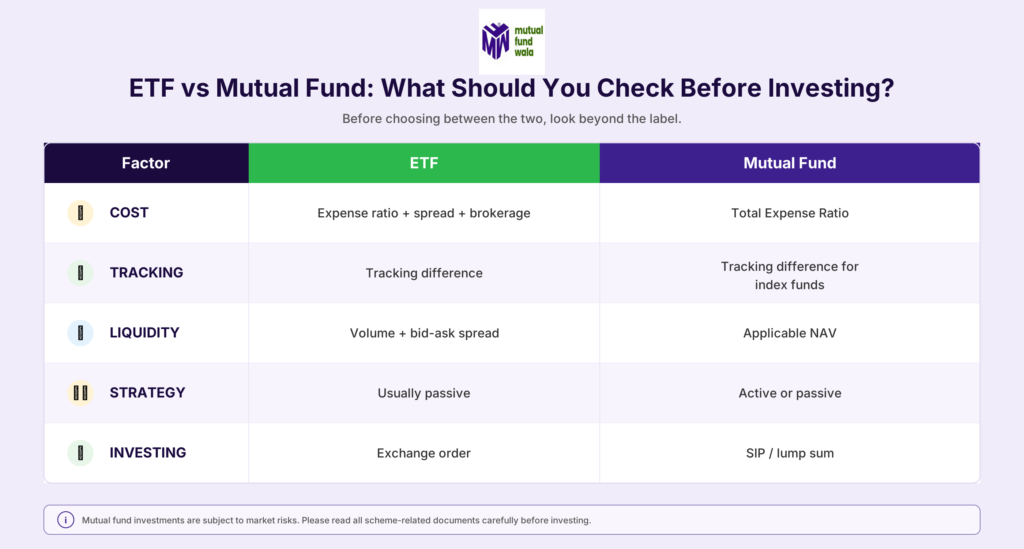
ETF vs Mutual Fund: What Should You Check Before Investing?
Conclusion
When you compare ETFs vs mutual funds, you will find that both offer different ways to build a diversified portfolio. If you already have a demat account and prefer exchange-based investing, lower-cost passive exposure and the flexibility to buy or sell during market hours, ETFs may fit your investment approach.
However, you should also consider liquidity, bid-ask spreads, brokerage and tracking error.
If you prefer investing through SIPs and want to invest a fixed amount every month, mutual funds can make the process easier. You can also choose between active and passive funds, depending on how you want your money managed. Keep in mind that active funds usually have higher expenses, while some mutual funds may also charge an exit load.
In the end, there is no need to choose an ETF or mutual fund simply because one looks cheaper or more flexible. Look at how you invest, the costs involved, the liquidity you need and the tax treatment. More importantly, choose an option that fits your financial goals and that you can stay invested in for the long run.
FAQs
What is the difference between an ETF and a mutual fund?
An ETF trades on stock exchanges at real-time market prices throughout trading hours. A mutual fund is bought or redeemed through the fund house or distributor at the applicable end-of-day NAV.
ETF vs mutual fund: which is better?
Neither is universally better. ETFs may suit investors who prefer buying and selling through a stock exchange, as they do with stocks. Mutual funds may be more convenient for someone who prefers hassle-free investing through SIPs without managing stock exchange orders.
Is an ETF cheaper than a mutual fund?
ETFs often have lower expense ratios, particularly passive ETFs, compared with active funds. As an investor, you should also consider brokerage, bid-ask spreads and other transaction costs.
Is a demat account required for ETFs?
Yes, a Demat and trading account is mandatory for buying and selling ETF units on stock exchanges.
Can I do SIP in ETFs?
Standard mutual fund SIPs are not directly available for ETFs. However, many modern broker platforms offer scheduled recurring orders to purchase full units at set intervals.