
 Shashi Kant Bahl
You may have heard of pension plans offered by life insurance companies. The pitch is simple: invest a fixed amount for 15 years, and the insurance company will provide you with a lifelong pension. This sounds appealing if your goal is to receive regular income after retirement.
However, these pension plans have drawbacks. The lock-in period means you have no flexibility, and the returns may not always be better than those offered by fixed deposits.
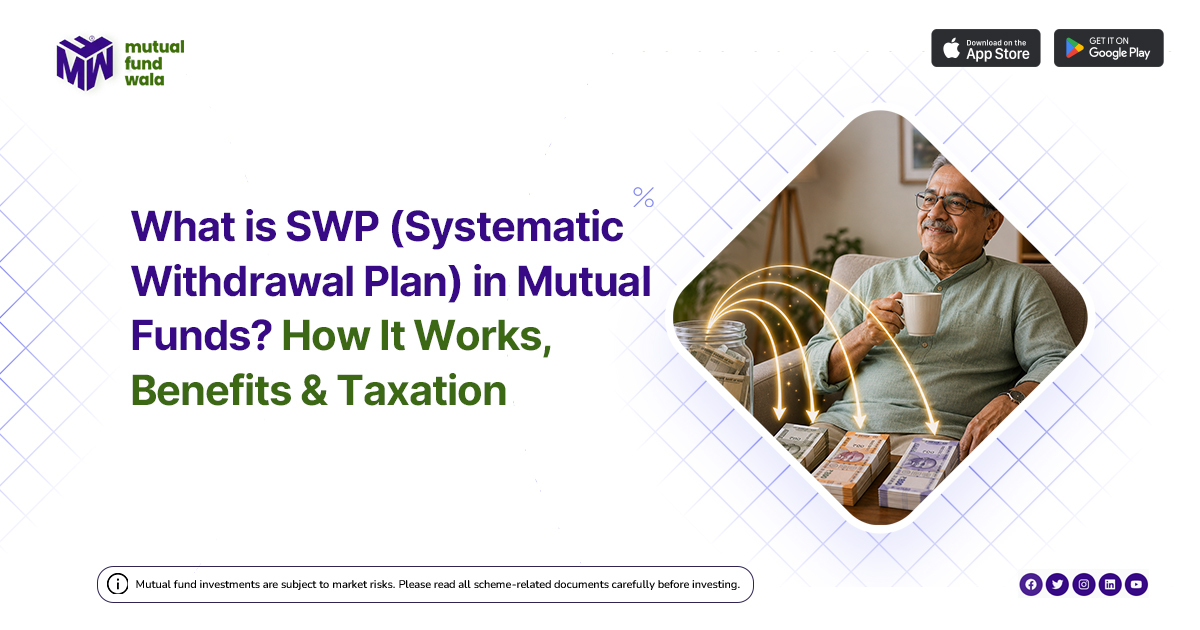
A Systematic Withdrawal Plan (SWP) in mutual funds offers a more flexible alternative. You can use your accumulated mutual fund corpus to generate monthly income from mutual funds, similar to a pension. You decide how much to withdraw and how often, while the remaining units stay invested and can continue to generate returns.
What is SWP (Systematic Withdrawal Plan)?
SWP in mutual funds is a facility that allows you to withdraw a fixed amount from your mutual fund corpus at regular intervals, monthly, quarterly, or annually.
For example, suppose you have accumulated 10,000 units of a mutual fund scheme at a NAV of ₹100, making your total corpus ₹10 lakh. Instead of withdrawing the entire amount at once, you can redeem a fixed amount every month, similar to receiving a monthly pension or salary.
In an SWP, the mutual fund redeems the required number of units at the prevailing NAV to meet each withdrawal. The remaining units stay invested and can continue to generate returns over time.
| Particulars | Details |
|---|---|
| Total Investment | ₹10,00,000 |
| SWP Amount | ₹5,000 per month |
| Expected Return (p.a.) | 10% |
| Time Period | 30 years |
| Total Withdrawal | ₹18,00,000 |
| Final Corpus After 30 Years | ₹71,35,186 |
In this example, you withdraw ₹5,000 every month for 30 years, totalling ₹18 lakh. After each withdrawal, the remaining corpus continues to earn an expected return of 10% per annum. At the end of 30 years, you could still have a corpus of approximately ₹71.4 lakh.
This shows how SWP allows you to generate regular income while keeping the remaining money invested, a useful feature for retirees or anyone needing periodic cash flow.
You can try our SWP Calculator to estimate your withdrawals and remaining corpus.
How Does an SWP Work?
- Setting Up: You start an SWP by specifying the withdrawal amount and frequency monthly, quarterly, semi-annually, or yearly. The withdrawal amount can be a fixed sum or a percentage of the investment value.
- Withdrawals: Once the SWP is set up, the mutual fund redeems the required number of units at the prevailing NAV on the chosen date and transfers the amount to your bank account.
- Flexibility: You can modify the SWP amount or frequency, pause or resume the plan, or stop it altogether at any time.
Benefits of an SWP
Monthly Income from Mutual Funds
Using an SWP, you can convert your accumulated corpus into regular cash flow monthly, quarterly, half-yearly, or annually. This is particularly useful for retirees, investors with irregular income, or anyone who has built a corpus for a specific goal.
Stay Invested
With an SWP, you don’t redeem your entire mutual fund investment at once. You redeem only the units needed to meet the withdrawal amount. The remaining units stay invested and can continue to generate returns over time.
However, market returns are not guaranteed, and excessive withdrawals can deplete your corpus faster. Set the withdrawal amount so the corpus can sustain withdrawals for as long as you need.
Tax Efficiency
SWPs can be more tax-efficient than lump-sum withdrawals. Each withdrawal involves redeeming only a portion of your units, and tax applies only to the capital gain component, not the entire withdrawal amount. This helps spread your tax liability across financial years.
| Particulars | Lump-Sum Withdrawal | Using SWP |
|---|---|---|
| Total Corpus | ₹10,00,000 | ₹10,00,000 |
| Withdrawal | ₹10,00,000 at once | ₹5,000/month (₹60,000/year) |
| Product | Equity Mutual Fund | Equity Mutual Fund |
| Holding Period | More than 1 year | More than 1 year |
| Capital Withdrawn | ₹1,00,000 | ₹10,000 |
| LTCG | ₹9,00,000 | ₹50,000 |
| LTCG Exemption | ₹1,25,000 | ₹1,25,000 |
| Taxable LTCG | ₹8,75,000 | NIL |
| Tax at 12.5% | ₹1,09,375 | NIL |
If you withdraw the entire ₹10 lakh at once, the gain of ₹9 lakh qualifies as LTCG, resulting in a tax liability of ₹1,09,375 at 12.5%. With a monthly SWP of ₹5,000 (₹60,000 yearly), the annual gain falls below the LTCG exemption of ₹1.25 lakh, meaning no tax is payable in this example.
Flexibility
SWP is as flexible as SIP. You can change the withdrawal amount, adjust the frequency, pause the facility, or stop it altogether making it easy to adapt when your financial needs change.
When Should You Use an SWP?
An SWP makes sense when you already have a sizeable mutual fund corpus and need regular cash flow. As shown in the example above, withdrawing ₹5,000 monthly from a ₹10 lakh corpus can still leave you with ₹71.4 lakh after 30 years.
SWP can be useful when you want to:
- Supplement pension income after retirement
- Meet recurring monthly expenses from your investments
- Create a planned cash-flow stream instead of making irregular lump-sum withdrawals
However, the withdrawal rate matters. If you withdraw too much relative to the portfolio’s long-term return, the corpus can decline rapidly especially during periods of weak market performance.
SWP vs SIP vs STP
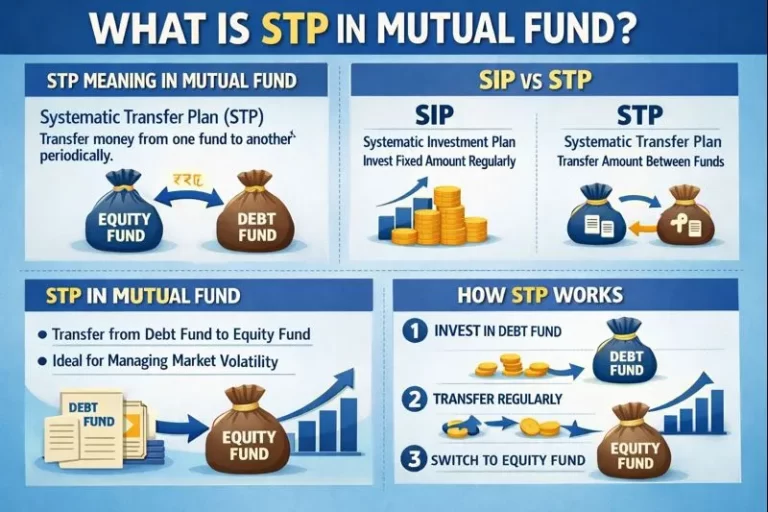
All three serve different purposes. SIP helps you build wealth through regular investments, SWP helps you withdraw your accumulated corpus periodically, and STP helps you transfer money from one mutual fund scheme to another.
| Feature | SWP | SIP | STP |
|---|---|---|---|
| Full Form | Systematic Withdrawal Plan | Systematic Investment Plan | Systematic Transfer Plan |
| Main Purpose | Withdraw money regularly | Invest money regularly | Transfer money between schemes |
| Direction | Investment → Bank account | Bank account → Mutual fund | One scheme → Another scheme |
| Common Use | Regular income | Wealth accumulation | Gradual transfer of corpus |
| Example | ₹10,000 withdrawn monthly | ₹10,000 invested monthly | ₹10,000 transferred monthly from debt to equity |
| Tax Implication | Redemption can create capital gains | Investment itself does not create capital gains | Transfer can trigger capital gains |
How is an SWP Taxed?
Every SWP withdrawal consists of two components: the principal (capital) you invested and the gains earned on it. You do not pay capital gains tax on the principal component. Tax applies only to the gains, and the rate depends on the type of fund and the holding period.
Equity Mutual Fund SWP
For equity-oriented mutual funds, units held for more than 12 months are subject to long-term capital gains (LTCG) tax at 12.5% on gains exceeding ₹1.25 lakh in a financial year. This exemption limit includes all LTCG made during the year across all equity investments.
Units sold within 12 months attract short-term capital gains (STCG) tax at a flat rate of 20%.
Debt Mutual Fund SWP
For debt mutual funds (with more than 65% allocation in debt instruments), all gains on units acquired on or after 1 April 2023 are treated as short-term capital gains, regardless of the holding period. These gains are added to your total income and taxed at your applicable income tax slab rate.
This means debt fund SWP withdrawals do not benefit from long-term capital gains treatment or indexation. If you fall in a hiHow is an SWP Taxed?
gher tax bracket, the tax outgo on debt fund SWP can be significant. It is worth factoring this into your withdrawal planning.
Exit Load
Before starting an SWP, check whether the mutual fund scheme charges an exit load. Many equity mutual fund schemes levy an exit load (typically 1%) if units are redeemed within one year of purchase. If your SWP starts soon after investing, the early withdrawals may attract exit load charges, reducing your effective returns. Choosing a scheme with a lower or nil exit load, or starting the SWP after the exit load period, can help avoid this cost.
How to Start an SWP
- Choose the mutual fund: Select the mutual fund investment from which you want to withdraw.
- Check SWP availability: Verify that the scheme offers an SWP facility and review its minimum withdrawal amount, frequency options, and exit load conditions.
- Set the withdrawal amount: Decide how much you want to withdraw each period.
- Select frequency and date: Choose whether you want monthly, quarterly, or annual withdrawals and pick the payout date.
- Submit the request: Place the SWP request through the mutual fund’s transaction platform, your distributor, or other permitted channels.
- Monitor and review: Periodically review the corpus and adjust the withdrawal amount as your financial needs and market conditions change.
Things to Consider Before Choosing an SWP
An SWP should not be selected simply because it provides monthly cash flow. The withdrawal strategy needs to fit the underlying investment and your financial requirements.
- Withdrawal rate: A high withdrawal rate can deplete the corpus quickly. Set the amount at a level that allows the corpus to sustain withdrawals for as long as you need.
- Market volatility: During a market downturn, an SWP redeems more units to generate the same amount of cash. This can erode the corpus faster than expected.
- Investment horizon: SWP is more suitable if you are invested for the long term and have already generated substantial wealth.
- Taxation: Each redemption can trigger capital gains tax depending on the type of fund and the holding period of the units being redeemed.
- Exit load: Some schemes charge an exit load on early redemptions. Check the scheme’s exit load structure before starting an SWP.
- Emergency fund: Do not depend entirely on an SWP for unexpected expenses. Maintaining a separate emergency fund can reduce the need for large additional redemptions from your investment.
Conclusion
SWP is a useful feature offered by mutual funds that allows you to convert your accumulated savings into regular cash flow. Instead of withdrawing the entire amount at once, you withdraw a fixed amount periodically while the remaining corpus stays invested.
The key is to set a withdrawal amount that allows your corpus to sustain the cash flow over time. You can also structure the SWP to optimise your tax outgo by staying within annual exemption limits.
However, SWP is a withdrawal strategy, not a guaranteed-return product. You need to balance the withdrawal rate, investment returns, time horizon, and taxes to make the best use of it.
Ready to set up an SWP? Explore SWP options with MutualFundWala.
FAQs
What is SWP in mutual fund?
SWP stands for Systematic Withdrawal Plan. It allows you to withdraw a fixed or variable amount from a mutual fund scheme at regular intervals – monthly, quarterly, or annually.
How does SWP work?
SWP works by redeeming a certain number of units at the applicable NAV to meet each withdrawal. The remaining units stay invested and can continue to generate returns over time.
Is SWP taxable?
Yes. The mutual fund redeems units to pay you, and if those units are sold at a gain, capital gains tax applies. The tax rate depends on the type of mutual fund, holding period, and prevailing tax rules.
Is SWP better than withdrawing a lump sum?
It depends on your objective. An SWP provides periodic cash flow without requiring you to withdraw everything at once. It can also help optimise tax liability by spreading gains across financial years. However, it does not eliminate market risk or guarantee that the corpus will last.
Can I stop or modify an SWP?
Yes. You can stop, pause, or modify an SWP at any time change the withdrawal amount, frequency, or discontinue it altogether.