

 Gaurav
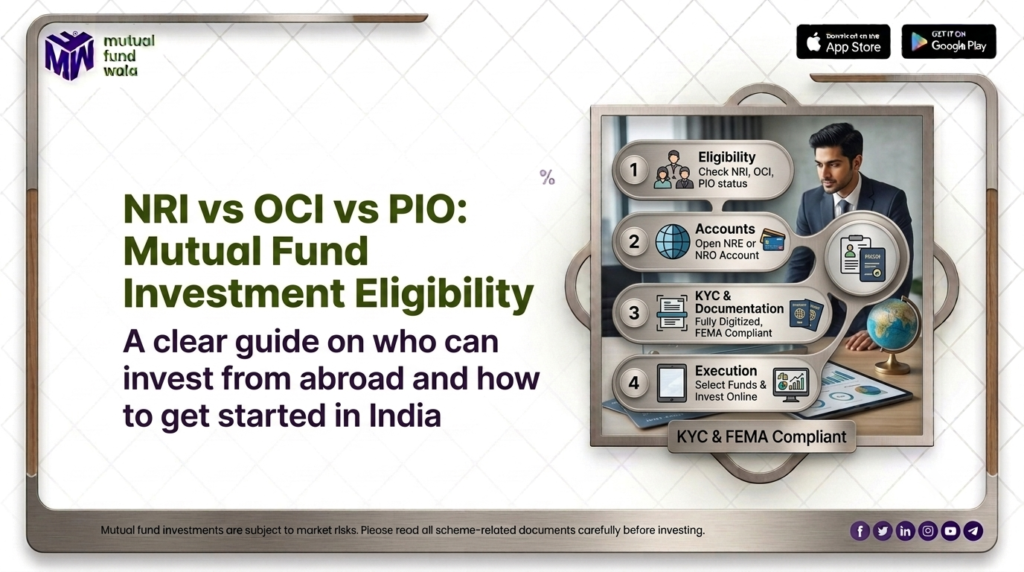
If you are an Indian citizen living abroad or a foreign national with Indian roots, you may have come across the terms NRI, OCI and PIO. Each of these categories carries different rights, and the question that matters most to investors is: can you invest in mutual funds in India?
The short answer is yes. Both NRIs and OCI cardholders can invest in Indian mutual funds under FEMA regulations. But the process, documentation, and tax treatment differ based on your residency status.
This page explains what NRI, OCI, and PIO mean, how they differ from each other, and walks you through the steps to start investing in mutual funds through MutualFundWala.
What Do NRI, OCI and PIO Mean?
Before exploring the investment process, here is a quick overview of each category.
NRI (Non-Resident Indian)
An NRI is an Indian citizen who lives outside India. Under the Income Tax Act, you qualify as an NRI if you have spent fewer than 182 days in India during a financial year. Under FEMA (Foreign Exchange Management Act), anyone who has moved abroad for employment, business, education or any other purpose with the intention of staying for an indefinite period is classified as an NRI.
Key point: An NRI holds an Indian passport. Citizenship does not change. Only the residency status changes.
OCI (Overseas Citizen of India)
An OCI is a foreign national of Indian origin who has been granted an Overseas Citizen of India card under Section 7A of the Citizenship Act, 1955. India does not allow dual citizenship, but the OCI card provides a lifelong, multiple-entry visa and several rights that are similar to what NRIs enjoy.
You are eligible for an OCI card if you were once an Indian citizen, have Indian ancestry, or are the spouse or child of an eligible person. Citizens of Pakistan and Bangladesh are not eligible.
Key point: An OCI holds a foreign passport, not an Indian passport. The OCI card is not citizenship. It is a special status that grants specific rights in India.
PIO (Person of Indian Origin)
PIO was a separate category for foreign citizens with ancestral ties to India. The PIO scheme was discontinued in 2015 and merged into the OCI programme. All existing PIO cardholders have been reclassified as OCI cardholders.
If you still hold a PIO card, you should convert it to an OCI card. The deadline set by the government is 31 December 2025.
Key point: PIO as a separate status no longer exists. For all practical purposes, PIO holders are now treated as OCI cardholders.
NRI vs OCI vs PIO: Key Differences at a Glance
| Feature | NRI | OCI | PIO |
|---|---|---|---|
| Citizenship | Indian citizen living abroad who qualifies as a non-resident | Foreign citizen of Indian origin holding an OCI card | The PIO card scheme was discontinued in 2015; eligible holders were encouraged to obtain OCI cards |
| Passport | Indian passport | Foreign passport | Foreign passport |
| Defined Under | Income Tax Act and FEMA, depending on the context | Citizenship Act, 1955 | PIO card scheme discontinued in 2015 |
| Visa for India | Not required because the person is an Indian citizen | OCI card generally provides a lifelong, multiple-entry visa, subject to applicable rules | Depends on current immigration status and documents |
| Can Invest in Mutual Funds | Generally yes, subject to applicable regulations, KYC requirements and fund-house policies | Generally yes, subject to applicable regulations, KYC requirements and fund-house policies | Depends on current OCI status and applicable investment rules |
| Bank Accounts in India | NRE, NRO and FCNR accounts, subject to eligibility | NRE and NRO accounts may be available; FCNR eligibility depends on applicable banking rules | Depends on current OCI status and applicable banking rules |
| Voting Rights | May register as an overseas elector, subject to eligibility | Not eligible while holding foreign citizenship | Same general position as other foreign citizens |
| Property Ownership | Residential and commercial property generally permitted; agricultural land, plantation property and farmhouses are restricted | Generally similar to NRIs, subject to applicable restrictions | Depends on current OCI status and applicable property regulations |
| Government Jobs | May be eligible for posts where Indian citizenship and other eligibility conditions are met | Generally not eligible for posts requiring Indian citizenship | Depends on citizenship and the eligibility requirements of the specific post |
Can NRIs Invest in Mutual Funds in India?
Yes. NRIs are permitted to invest in Indian mutual funds under FEMA regulations. No separate RBI approval is needed for each transaction.
NRIs can invest in all categories of mutual funds: equity funds, debt funds, hybrid funds, index funds, ELSS and liquid funds. SIP (Systematic Investment Plan) and lumpsum investments are both available.
What NRIs need to know:
- Investments must be made in Indian rupees, not in foreign currency
- You need an NRE (Non-Resident External) or NRO (Non-Resident Ordinary) bank account to invest
- Investments through an NRE account are fully repatriable, meaning both principal and returns can be transferred abroad
- Investments through an NRO account are also repatriable, subject to applicable limits
- FCNR (Foreign Currency Non-Resident) deposits cannot be used to directly fund mutual fund purchases
- NRIs based in the US and Canada can invest, but some fund houses may not accept investments from these countries due to FATCA compliance requirements. Several major AMCs do accept US and Canada NRIs
Repatriation explained: If you invest through your NRE account, you can transfer the investment amount and any gains back to your country of residence freely. This is one of the reasons many NRIs prefer the NRE route for mutual fund investments.
Can OCI Cardholders Invest in Mutual Funds in India?
Yes. Under FEMA, OCI cardholders are treated at par with NRIs for most financial investments, including mutual funds. OCI holders can invest in equity, debt and hybrid mutual funds using their NRE or NRO bank accounts.
The documentation and process are largely the same as for NRIs, with a few additions. OCI investors need to provide their OCI card details along with their foreign passport, PAN card and KYC documents.
Important for OCI investors:
- A valid PAN card is mandatory for mutual fund investments
- FATCA (Foreign Account Tax Compliance Act) and CRS (Common Reporting Standard) declarations are required
- OCI cardholders investing from the US may face additional compliance due to PFIC (Passive Foreign Investment Company) rules under US tax law. It is advisable to consult a cross-border tax professional
KYC Requirements for NRI and OCI Mutual Fund Investors
KYC (Know Your Customer) verification is mandatory before you can invest in any mutual fund in India, regardless of whether you are an NRI or OCI.
Documents typically required:
- Valid passport (Indian passport for NRIs, foreign passport for OCIs)
- OCI card (for OCI cardholders)
- PAN card
- Proof of overseas address (utility bill, bank statement or overseas driving licence)
- Passport-size photographs
- FATCA/CRS self-declaration form
- NRE or NRO bank account details
How to complete KYC:
KYC can be completed online through NSDL or UTIITSL (CAMS KRA). If you have an authorised representative or Power of Attorney (PoA) holder in India, they can submit physical KYC documents on your behalf. The PoA holder’s signature must also be attested.
SEBI has mandated nomination for all mutual fund folios since March 2025. Make sure you complete the nomination process when setting up your investment.
KYC validation deadline: NRIs need to get their KYC status upgraded to “Validated” by linking Aadhaar with PAN. The current deadline for this is 30 April 2026 (extended from April 2025). Without validated KYC, future investments may be restricted.
Taxation of Mutual Fund Returns for NRIs and OCIs
Both NRIs and OCI cardholders are subject to the same mutual fund taxation rules in India. The key difference from resident investors is that TDS (Tax Deducted at Source) is applicable on mutual fund redemptions for NRIs and OCIs. For a detailed breakdown specific to NRIs, see our guide on mutual fund taxation for NRIs.
| Fund Category | Type of Gain | Holding Period | Tax Rate |
|---|---|---|---|
|
Equity-Oriented Mutual Funds (65% or more in equity) |
Short-Term Capital Gains (STCG) | Up to 12 months | 20% |
| Long-Term Capital Gains (LTCG) | More than 12 months | 12.5% on gains above ₹1.25 lakh per financial year | |
|
Debt-Oriented Mutual Funds (equity allocation below 65%) |
Short-Term Capital Gains (STCG) | Up to 24 months | Taxed at the investor's applicable income tax slab |
| Long-Term Capital Gains (LTCG) | More than 24 months | 12.5% |
TDS for NRIs and OCIs: Unlike resident Indians, NRIs and OCIs face TDS on mutual fund redemption proceeds. The fund house deducts TDS before crediting the redemption amount to your bank account. You can claim credit for TDS paid while filing your income tax return in India.
Double Taxation Avoidance Agreement (DTAA): India has DTAA agreements with over 90 countries. If your country of residence has a DTAA with India, you may be able to claim credit for taxes paid in India against your tax liability in your home country. This helps avoid paying tax on the same income twice. Consult a tax professional familiar with cross-border taxation to understand how DTAA applies to your specific situation.
Tax rules are based on current provisions and can change. Always verify the latest rates before making investment decisions.
How to Invest in Mutual Funds Through MutualFundWala as an NRI or OCI
MutualFundWala is an AMFI-registered Mutual Fund Distributor (ARN-275889). NRIs and OCI cardholders can invest through our platform. Here is how.
Step 1: Open an NRE or NRO bank account If you do not already have one, open an NRE or NRO account with any Indian bank. This account will be used for all mutual fund transactions. Choose NRE if you want full repatriation of your investment and returns.
Step 2: Complete your KYC Get your KYC done through NSDL or UTIITSL. You will need your passport, PAN card, overseas address proof and a FATCA declaration. KYC can be completed online in most cases.
Step 3: Choose your investment mode
- SIP (Systematic Investment Plan): Start a monthly SIP from as low as ₹100. Set up an auto-debit from your NRE or NRO account. SIP helps you invest regularly without needing to time the market. You can also consider a step-up SIP to increase your investment amount annually.
- Lumpsum: Invest a one-time amount. Minimum amounts vary by fund, typically ₹1,000 to ₹5,000.
You can estimate your potential corpus using our SIP calculator.
Step 4: Select a mutual fund scheme Browse available schemes on our platform. You can choose from equity funds, debt funds, hybrid funds, ELSS (tax-saving funds), index funds and more. Compare expense ratios, historical returns and riskometer ratings.
Step 5: Complete the transaction Submit your investment through MutualFundWala. For SIP, set up auto-debit on your preferred date. For lumpsum, transfer the amount from your NRE or NRO account.
Step 6: Track your investments Monitor your portfolio through your MutualFundWala account. You can track NAV movements, review returns and manage redemptions from anywhere in the world.
For any questions about the process, reach out to us at +91-9891257575 (call or WhatsApp) or email info@mutualfundwala.com.
Things to Keep in Mind
Fund house restrictions for US and Canada NRIs: Not all AMCs (Asset Management Companies) accept investments from NRIs based in the US and Canada due to FATCA compliance costs. Before selecting a scheme, check whether the fund house accepts investments from your country of residence. Several major fund houses, including SBI Mutual Fund and ICICI Prudential, do accept US and Canada NRI investors.
Power of Attorney (PoA): If you cannot manage your investments directly from abroad, you can appoint a PoA holder in India. The PoA holder can complete KYC, submit application forms and manage redemptions on your behalf. Both your signature and the PoA holder’s signature must be present on the KYC documents.
Status change: If you return to India and become a resident again, your mutual fund investments continue. You will need to update your KYC status from NRI to Resident and convert your NRE/NRO account to a regular savings account.
Existing investments: If you had mutual fund investments as a resident Indian and later became an NRI, your existing investments are not affected. You can continue holding them, make additional investments and redeem when needed. However, you must update your residency status with the fund house and your KYC records.
Frequently Asked Questions
Can NRIs start a SIP in mutual funds?
Yes. NRIs can start a SIP through MutualFundWala from as low as ₹100 per month. The SIP amount is auto-debited from your NRE or NRO bank account on the date you choose.
Can OCI cardholders invest in mutual funds in India?
Yes. OCI cardholders are treated at par with NRIs for mutual fund investments under FEMA. You can invest in equity, debt and hybrid funds using an NRE or NRO account.
Is a PAN card mandatory for NRI mutual fund investment?
Yes. A PAN card is mandatory for all mutual fund investments in India, regardless of residency status. NRIs and OCIs must also complete FATCA/CRS declarations.
Can NRIs invest in ELSS (tax-saving) funds?
Yes. NRIs can invest in ELSS funds. However, the tax deduction under Section 80C is available only if the NRI has taxable income in India. ELSS funds have a 3-year lock-in period.
Do NRIs have to pay TDS on mutual fund redemptions?
Yes. Unlike resident Indians, NRIs and OCIs are subject to TDS on mutual fund redemption proceeds. The fund house deducts TDS before crediting your account. You can claim TDS credit when filing your income tax return.
Are mutual fund returns repatriable for NRIs?
Yes. If you invest through an NRE account, both the principal and returns are fully repatriable. Investments through NRO accounts are also repatriable, subject to applicable limits and after TDS deduction.