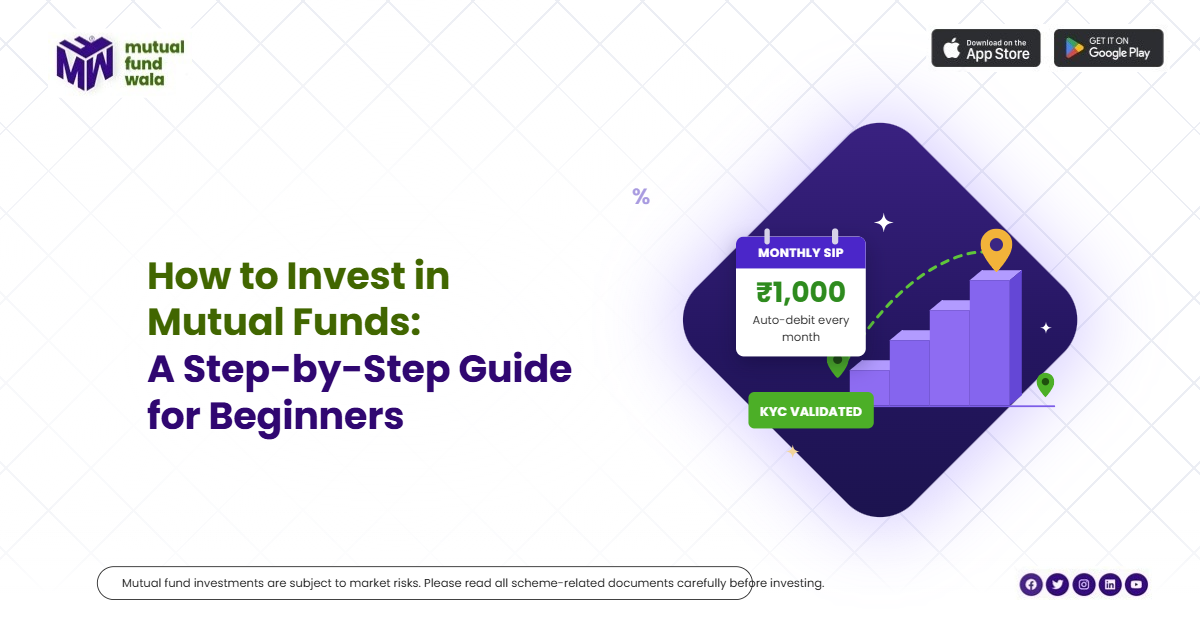
To invest in mutual funds in India, complete your KYC with your PAN and Aadhaar, pick a fund category that matches your goal and time horizon, and invest through a SIP (a fixed amount every month) or a lumpsum. You can do this online through a fund house, an investment app or a mutual fund distributor, and many funds let you start a SIP with as little as ₹100 a month.
This guide walks you through each step, from understanding fund types to tracking your investments.
What Is a Mutual Fund?
A mutual fund pools money from many investors and invests it in stocks, bonds, or other assets. A professional fund manager runs the portfolio according to the fund’s stated objective. When you invest, you receive units of the fund, and each unit’s value (the NAV) rises or falls with the value of the fund’s investments.
Mutual funds in India are regulated by SEBI (the Securities and Exchange Board of India).
Types of Mutual Funds
Debt funds carry interest-rate and credit risk, so they are less volatile than equity funds but are not guaranteed.
ELSS funds offer a deduction of up to ₹1.5 lakh a year under Section 80C, but only under the old tax regime.
Step 1: Set Your Goal and Time Horizon
Start with what you’re investing for and when you’ll need the money: a home in 10 years, your child’s education in 15, retirement in 25, or an emergency buffer you may need any time. Your time horizon matters more than anything else in choosing a fund category:
- Money needed within 1–3 years: equity funds are usually too volatile, because a market fall may not recover in time.
- Money needed in 5+ years: there’s more time to ride out market ups and downs.
Step 2: Understand Your Risk Comfort
Every mutual fund shows a risk-o-meter that rates its risk from Low to Very High. Ask yourself one question: if your investment fell 20% in a bad year, would you stay invested or panic and sell? Choose funds whose risk level you can live with, not just the ones with the highest past returns.
Step 3: Complete Your KYC
KYC (Know Your Customer) is a one-time identity check that every mutual fund investor in India must complete. Once done, it works across all fund houses.
You’ll need:
- PAN card
- Aadhaar, with your current mobile number linked for OTP verification
- A recent photograph
- Bank account details
How to complete it:
- Online, through a KYC Registration Agency (KRA) such as CVL KRA, CAMS KRA or KFintech KRA, using Aadhaar-based eKYC
- Through a fund house’s website or app
- Through a mutual fund distributor, who completes it for you
Check your KYC status on any KRA website, such as cvlkra.com, using your PAN.
- “KYC Validated” means you can invest with any fund house.
- “KYC Registered” usually means you can invest with fund houses you already use, but may need to update KYC for new ones.
- “On Hold” means you need to fix the issue, often a mismatched mobile number or email, before investing.
Step 4: Choose How to Invest: Direct or Regular Plan
Both versions invest in exactly the same portfolio. The difference is cost versus support.
- Direct plans suit people who are comfortable researching funds and handling transactions themselves.
- Regular plans suit people who want help with paperwork, service requests and tracking.
Before choosing a distributor, check that their ARN (AMFI Registration Number) is active on AMFI’s website.
Step 5: Choose a Fund
Once you know your category, compare a few funds within it:
- Consistency: look at returns over 3, 5 and 7 years, not just last year. A fund that topped the charts last year often doesn’t repeat it.
- Expense ratio: the annual fee charged by the fund. A lower ratio leaves more of the returns with you.
- Risk-o-meter: make sure it matches your comfort level.
- Fund size and track record: very new or very small funds have less history to judge.
- Exit load: a small charge if you withdraw early, often within one year. Check the period before investing.
Past performance doesn’t guarantee future returns. Use it to see how a fund behaved in different market conditions, not to predict the future.
Step 6: Invest Through a SIP or Lumpsum
SIP (Systematic Investment Plan): You invest a fixed amount every month through an automatic bank debit. Some funds let you start from ₹100 a month.
- You buy more units when prices fall and fewer when they rise, which averages your cost over time.
- It builds a saving habit without needing a large amount upfront.
Lumpsum: You invest a larger amount in one go, such as a bonus or savings.
- Your full amount starts compounding from day one.
- Timing matters more, since everything is invested at one price.
Most first-time investors with a monthly income start with a SIP. To see what a SIP could grow into, try our SIP Calculator.
To place your first investment: log in to your chosen platform, select the fund, choose SIP or lump sum, enter the amount, and set up the bank mandate or payment. Your units are allotted at the NAV of the transaction day, according to the fund’s cut-off time.
Step 7: Track and Review Your Investments
- Review once or twice a year, not daily. Check whether each fund is still doing its job compared with similar funds over 3+ years.
- Rebalance when your mix drifts. If equity has grown much larger than you planned, you may want to move some money to debt or hybrid funds to bring your risk back in line.
- Use your CAS (Consolidated Account Statement) from CAMS, KFintech or MFCentral to see all your funds in one place.
- Increase your SIP as your income grows. Even a 10% increase every year makes a big difference over time.
Common Mistakes First-Time Investors Make
- Chasing last year’s top performer. Judge consistency over 3–5 years instead.
- Stopping SIPs when markets fall. Falls are when your SIP buys more units at lower prices.
- Investing short-term money in equity funds. Match the fund to when you’ll need the money.
- Putting everything in one fund or category. Spread across categories based on your goals.
- Never reviewing. Your goals and life change, so your investments should be reviewed too.
How Mutual Fund Gains Are Taxed
Equity funds (65% or more in Indian shares):
- Short-term: units held for 12 months or less are taxed at 20%.
- Long-term: units held for more than 12 months are taxed at 12.5% on gains above ₹1.25 lakh in a financial year.
Debt funds:
- Units bought on or after 1 April 2023 are taxed at your income tax slab rate, however long you hold them, with no indexation benefit.
- Older units follow different rules.
Tax rules change from time to time, so check the current rules or speak with a tax professional before you withdraw.
FAQs


 Shashi Kant Bahl