What Is a Value Mutual Fund?
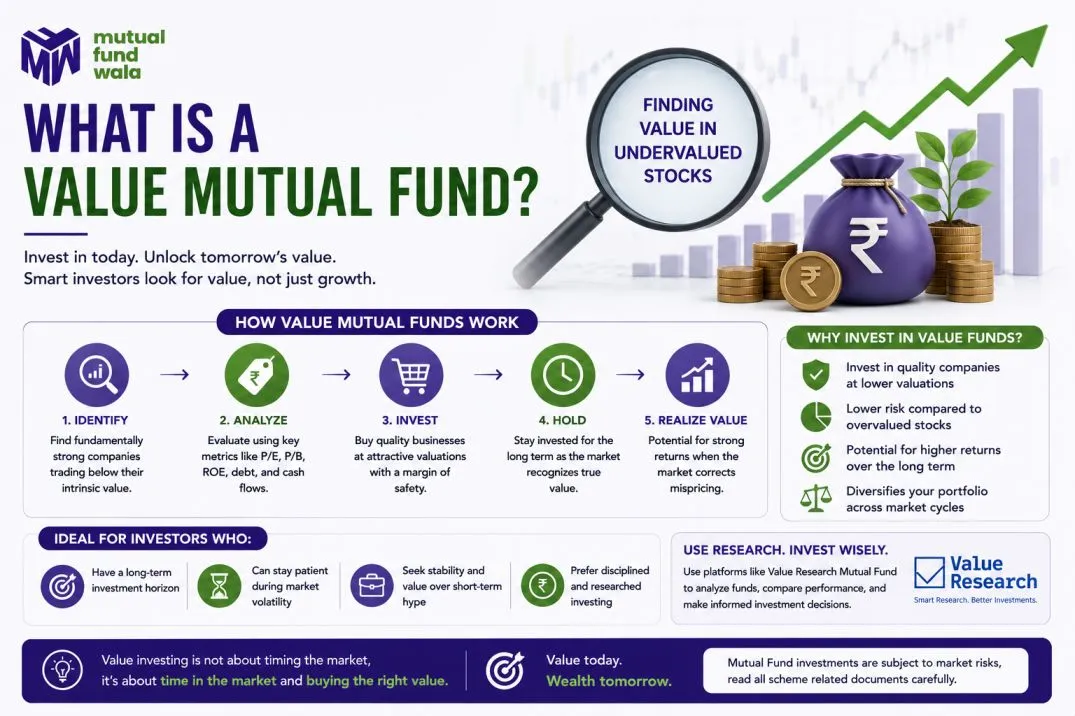
The simplest explanation of “What Is a Value Mutual Fund” is that it is a mutual fund category that invests in undervalued companies.
These funds try to identify stocks trading below what fund managers believe is their fair or intrinsic value. The belief is simple. Markets sometimes ignore good businesses due to temporary problems, weak sentiment, or sector slowdowns.
Instead of chasing expensive stocks, value mutual funds look for companies that may recover over time.
For example, a fundamentally strong manufacturing or banking company facing temporary challenges may trade at cheaper valuations. A value fund manager may view this as an opportunity instead of a risk.
This is the basic idea behind what is a value fund.
Value Fund Meaning Explained in Simple Terms
The easiest way to understand the meaning of a value fund is to think about shopping.
Suppose a high-quality product worth ₹10,000 becomes available at ₹7,000 during a sale. Many buyers may see it as an attractive purchase because they pay less than it is worth.
Investing works similarly.
A value investing strategy looks for businesses that appear undervalued relative to earnings, assets, cash flow, or future potential.
This simple example explains the value fund concept.
Rather than paying premium prices for fashionable companies, value funds aim to invest where upside potential may still remain.
How Do Value Mutual Funds Work?
To understand What Is a value mutual fund is, investors should know how these funds select stocks.
Buying Undervalued Businesses
A value strategy generally focuses on companies trading at attractive valuations.
Fund managers may analyse:
- Price to earnings ratio
- Price to book value
- Cash flow strength
- Earnings visibility
- Business quality
For instance, if a strong company faces temporary pressure because of slowing demand or weak sentiment, a value fund manager may see a long-term opportunity.
This patient’s investing style is reflected in many value mutual funds.
Long-Term Investment Approach
Value investing rarely delivers instant results.
Sometimes, undervalued stocks remain ignored for years before markets recognise their potential. Because of this, investors in value strategies often need patience.
For example, a banking stock trading at a discount during an economic slowdown may recover only after business conditions improve.
This is why understanding the value fund’s meaning also means understanding long-term investing.
Focus on Margin of Safety
A key principle of value investing is buying companies at reasonable prices.
Since stocks are purchased at lower valuations, investors may get some cushion against downside risk compared to buying expensive companies at peak valuations.
However, lower valuation alone does not guarantee success. Some businesses may remain weak for valid reasons.
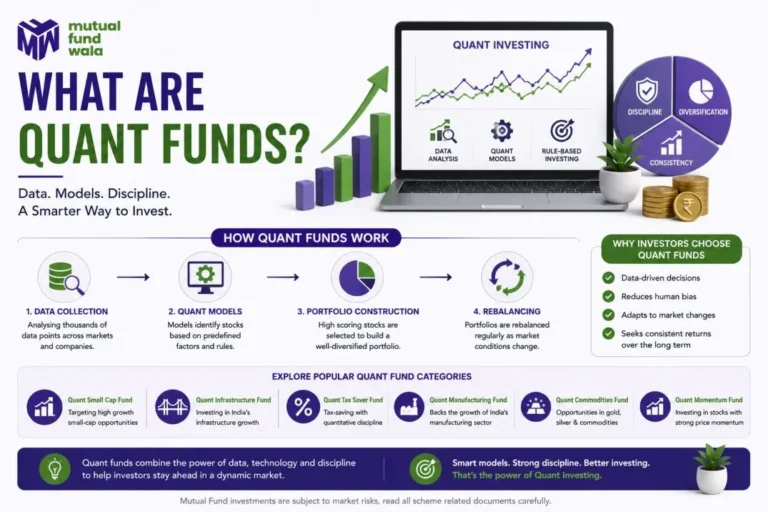
Read More: What Are Quant Funds and Should You Invest in Them?
What Is a Value Fund and Why Do Investors Choose It?
Many investors asking what is a value fund also wonder why someone would prefer it over growth-oriented investing.
One reason is valuation comfort.
Growth investing often focuses on companies already doing well and trading at high prices. Value investing focuses on companies available at attractive valuations.
For investors uncomfortable paying premium prices, value strategies may feel more disciplined.
Another reason is diversification.
During certain market phases, expensive growth stocks may underperform while value-oriented companies recover strongly.
This rotation is one reason many investors include value mutual funds in their portfolio.
Are Value Mutual Funds Better Than Growth Funds?
There is no universal winner.
Growth funds focus on companies expected to grow rapidly.
Value funds focus on companies that appear undervalued.
During bullish markets, growth investing may outperform as investors aggressively chase future potential.
During market corrections or valuation resets, value investing may perform relatively better because downside expectations are already lower.
So, the choice depends on investor temperament and market cycles rather than superiority.
How to Evaluate Value Mutual Funds
Investors researching what a value mutual fund is should avoid choosing schemes based only on recent returns.
Instead, consider:
Investment Style Consistency
A strong value strategy should consistently focus on valuation discipline rather than chasing market trends.
Portfolio Quality
Look at sector diversification and stock quality.
Cheap stocks alone are not enough. Strong businesses matter.
Long Term Performance
Since value investing takes time, short-term underperformance should not become the only basis for judgment.
Many investors also compare ratings and historical data on platforms that discuss value research, mutual fund insights, or online mutual fund data to better understand portfolio behaviour.
What about the Net Asset Value Mutual Fund?
Many beginners confuse value investing with a net asset value mutual fund.
They are completely different concepts.
A net asset value mutual fund refers to the per-unit market value of a mutual fund scheme.
For example, if a fund has a NAV of ₹50, it only reflects unit pricing and does not indicate whether the fund follows value investing.
In contrast, What Is a Value Mutual Fund refers to a specific investment style focused on undervalued businesses.
Understanding this distinction helps investors avoid confusion.
Who Should Invest in Value Mutual Funds?
Value mutual funds may suit investors who:
- Prefer valuation-conscious investing
- Have patience for long holding periods
- Can tolerate temporary underperformance
- Want diversification across investing styles
For example, an investor investing for retirement over 15 years may allocate a portion of equity exposure toward value strategies while remaining invested through market cycles.
Conclusion
Understanding what a Value Mutual Fund is helps investors appreciate a patient, disciplined investing style built around undervalued opportunities. At Mutual Fund Wala, we believe this approach can play an important role in long-term wealth creation.
Rather than chasing expensive stocks, these funds look for businesses trading below their perceived fair value, on the belief that markets eventually recognise quality. This value-conscious philosophy aligns with the investment approach promoted by Mutual Fund Wala.
Still, investors should remember that value investing requires patience. Returns may not appear immediately, and underperformance during certain periods is possible. For long-term investors comfortable with waiting through cycles, value mutual funds can become a useful part of a diversified portfolio. Mutual Fund Wala encourages investors to focus on long-term fundamentals rather than short-term market movements.
FAQs
Like This Blog? Share With Others


 Shashi Kant Bahl