What Are Quant Funds?
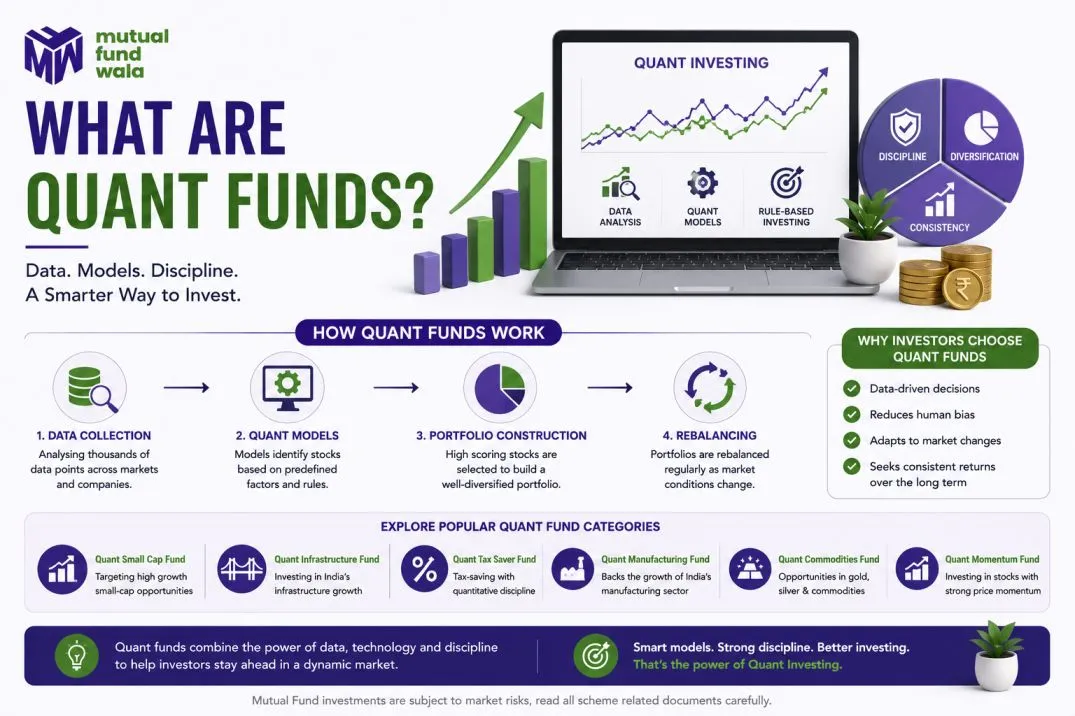
The simplest answer to What are Quant Funds is that they are mutual funds that use mathematical models, data, and predefined rules to select investments.
Unlike traditional funds, where fund managers may rely heavily on judgment, quant investing follows systems driven by measurable factors. These models evaluate thousands of data points before deciding which stocks to allocate to.
For example, a quantitative system may analyse:
- Company valuations
- Earnings growth
- Price momentum
- Risk levels
- Balance sheet quality
In simple words, what is quant fund can be understood as a mutual fund strategy where numbers and data influence decisions more than emotions or instincts.
This does not mean humans disappear from the process. Fund managers still supervise portfolios and manage risk, but the stock selection framework remains data-driven.
How Do Quant Funds Work?
To better understand What Are Quant Funds are, it helps to know how these funds build portfolios.
Data-Based Stock Selection
A quant strategy studies a large amount of financial and market information before selecting investments.
For example, the system may identify companies showing improving profits, lower debt, attractive valuations, or strong price momentum. Rather than relying on subjective opinions, the process follows predefined investment rules.
This structured approach makes quant mutual fund strategies feel more disciplined during uncertain market phases.
Portfolio Rebalancing
Markets constantly change, and quant models adapt accordingly.
If a stock no longer meets certain conditions, it may be removed and replaced with another company that scores better on predefined factors. This data-driven approach supports regular portfolio rebalancing, allowing the portfolio to adjust to changing market conditions without emotional decision-makin
For investors, this means the portfolio evolves based on data rather than market sentiment.
Factor-Based Investing
Many quant strategies rely on investing “factors.”
For example:
- Momentum focuses on stocks showing strong price trends
- Quality focuses on financially stronger businesses
- Value focuses on attractively priced companies
This explains the growing popularity of products such as the quant momentum fund, where portfolio decisions may be linked to trend-based investing frameworks.
Are Quant Funds Better Than Traditional Mutual Funds?
A common investor question is, are quant funds better?
The answer depends on expectations and investment style.
Less Emotional Investing
One advantage of quant investing is discipline.
Markets often move based on fear and greed. During corrections, emotions may push investors or even fund managers toward poor decisions. A quantitative strategy follows rules instead of panic or excitement.
This creates consistency in decision-making, especially during volatile periods.
Ability to Process Large Data Quickly
Human fund managers can analyse only a limited amount of information at a time.
Quant models, however, can process massive datasets quickly and identify patterns that may otherwise be missed. This makes the investment process faster and more systematic.
But Underperformance Is Still Possible
Investors should remember that no strategy guarantees success.
Even a strong quant mutual fund can underperform during certain market phases if its model assumptions temporarily break down. A system built around momentum, for example, may struggle during sharp market reversals.
So, when asking are quant funds are better, investors should think of them as different rather than automatically superior.
Popular Quant Investing Categories
As awareness grows, investors increasingly search for category-specific products.
For instance, investors looking at small-cap opportunities often search for terms like quant small-cap fund direct growth, quant small-cap fund regular growth, and quant small-cap fund regular because they want exposure to higher-growth businesses through a systematic process.
Similarly, investors interested in sectors may come across products linked to a quant infrastructure fund, a quant commodities fund, or a quant manufacturing fund, which combine thematic investing with a quantitative framework.
Tax-saving investors may also explore a quant tax saver fund, where ELSS benefits meet systematic investing.
Another search term gaining traction is DSP Quant Fund, reflecting growing investor interest in quantitative strategies offered by different asset managers.
However, investors should avoid selecting a scheme only because it carries the “quant” label. Understanding the investment process matters more than trends.
Is Quant Investing Risk-Free?
No investment strategy is risk-free.
Even though quant investing sounds scientific, it still faces market uncertainty.
A model may identify good opportunities, but external factors such as economic slowdown, policy changes, or sector weakness can hurt performance.
Similarly, small-cap strategies linked to a quant small-cap fund direct growth or a quant small-cap fund regular growth may experience sharp volatility because small caps themselves carry higher risk.
In simple words, quant investing reduces emotional bias, not investment risk.
Who Should Invest in Quant Funds?
Understanding What Are Quant Funds are also means understanding who they suit.
These funds may work for investors who prefer structured investing and can stay patient through market cycles. Someone already investing in diversified equity funds may consider adding a smaller allocation to quant strategies for diversification.
However, beginners should avoid assuming that a quant mutual fund guarantees better returns.
The focus should remain on financial goals, risk appetite, and long-term discipline rather than chasing performance trends.
Conclusion
Understanding What Are Quant Funds helps investors see how technology and data are reshaping investing.
Rather than relying entirely on human judgment, these funds use predefined models and quantitative signals to build portfolios. Whether looking at a quant momentum fund, a quant infrastructure fund, or a quant tax saver fund, the underlying principle remains systematic decision-making.
At Mutual Fund Wala, we believe investors should understand both the opportunities and limitations of quantitative investing before making investment decisions.
Still, investors should avoid assuming that quant investing automatically means higher returns. Like every investment strategy, quant funds go through strong and weak phases. For long-term investors, these funds may work best as part of a diversified portfolio rather than a one-stop solution.
FAQs
Like This Blog? Share With Others


 Shashi Kant Bahl