

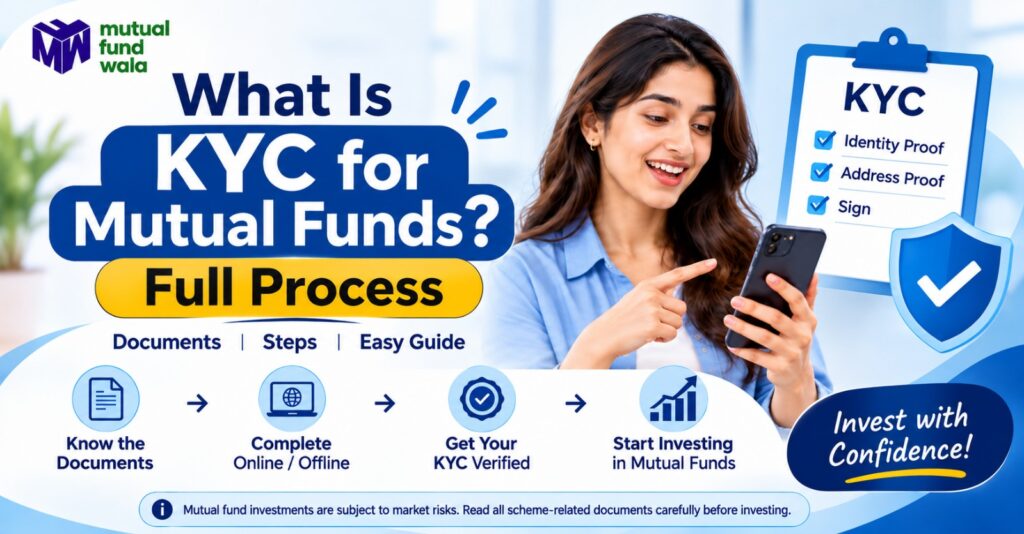
Before you can invest in mutual funds, regulatory authorities require you to complete a mandatory verification step called Know Your Customer (KYC). This process safeguards your account by confirming your identity and address to ensure secure, compliant transactions.
Once a paper-heavy administrative task, onboarding is now faster and more accessible thanks to digital solutions like Aadhaar-based authentication and Video KYC. Using just your Permanent Account Number (PAN) and a valid proof of identity, you can now complete the entire process from home.
This guide explains how mutual fund KYC works, the documents you need, and a step-by-step walkthrough of how to complete your verification online.
What is KYC in Mutual Funds?
KYC for mutual funds is a one-time identity and address verification process that investors must complete before investing. It helps mutual fund companies and financial institutions verify an investor’s identity and maintain accurate client records.
In simple terms, KYC confirms that you are the person making the investment. It also helps financial institutions meet regulatory requirements and prevent identity fraud and money laundering.
Why is KYC Required for Mutual Fund Investments?
KYC is a process by which mutual funds verify investors’ identities and addresses. This helps financial institutions comply with regulations, maintain investor records and reduce fraud risk. Just like you can’t open a bank account without KYC, you can’t invest in mutual funds without KYC.
Here is why the process matters:
- Identity Verification: Confirms the identity of the person making the investment.
- Address Verification: Helps keep residential and communication details accurate.
- Prevents Fraud: Reduces the risk of identity misuse and suspicious transactions.
- Regulatory Compliance: Regulators need mutual fund companies and intermediaries to maintain KYC records for investors.
- FATCA Compliance: FATCA self-certification is mandatory for all investors opening or holding mutual fund folios. This is needed to declare your tax residency status.
KYC Documents Required for Mutual Funds
To complete your mutual fund KYC, you need to provide your PAN for tax identification, an Aadhaar card, passport, voter ID, or driving licence as proof of identity and address, along with your photograph, signature, and contact details.
Some of the common documents required include:-
| Document | Purpose |
|---|---|
| PAN | Identity and tax identification |
| Aadhaar Card/Passport/Voter ID/ Driving License | Identity and address verification |
| Birth Certificate | In case of minor |
| Non-Individuals | Certificate of incorporation, partnership deed, and PAN of authorised signatories. |
| Photograph and Signature | Investor identification |
| Mobile Number and Email ID | OTP verification and communication |
Make sure the details you submit match your official documents.
Mutual Fund KYC Process: Step-by-Step
You can verify your mutual fund KYC using your personal details, PAN and address proof, and completing video verification (if doing online). You can complete the process online or through an authorised intermediary.
Here is how the process generally works.
- Choose a KYC platform
You can complete your mutual fund KYC online through KRA portals such as CVL KRA, CAMS, and Karvy KRA, as well as the KFintech investor portal and authorised mutual fund platforms. Start the new investor KYC process.
- Enter your personal details
Provide your name, date of birth, PAN, mobile number, email address, and residential address.
- Upload the required documents
Submit the documents requested for identity and address verification. These may include your PAN and an accepted address proof.
- Complete identity verification
You may need to complete Aadhaar-based authentication, OTP verification, in-person verification or video verification.
- Submit your application
Review and submit the KYC application. You may receive an acknowledgement or reference number to track its progress.
- Wait for verification
The KRA or relevant intermediary will review your details and documents. Once verification is complete, your KYC status will be updated.
After successful verification, you can proceed with mutual fund investments, subject to the applicable KYC status and other transaction requirements.
How to Do KYC for Mutual Funds Online?
You can complete KYC online through KRA portals like CVL KRA, CAMS, and Karvy KRA as well as KFintech Investor Portal and authorised mutual fund platforms. You need to provide your PAN and personal details, upload the required documents and complete the digital verification.
Follow these steps:
- Visit an authorised investment platform/KRA website.
- Select the new investor KYC option.
- Enter your PAN and personal details.
- Provide your mobile number and email address.
- Upload the required identity and address documents.
- Complete the available verification process.
- Submit the application and save the acknowledgement number.
- Check your KYC status after the verification process.
Online KYC saves time because you don’t need to visit a physical office or submit paper documents. If you opted for Aadhaar-based online KYC, it typically takes 3 to 5 working days. Non-Aadhaar or physical offline applications take 10 to 15 working days because they require manual verification.
If you are investing through an online investment platform, including MutualFundWala, check the available KYC assistance and onboarding facilities.
What Is Video KYC for Mutual Funds?
Video KYC is a live, paperless online verification method. It lets mutual fund investors complete their mandatory KYC from home. It replaces traditional physical branch visits or in-person verification.
How Video KYC Works:-
- Enter details: like PAN, mobile number and email ID on the authorised KYC platform.
- Aadhaar/DigiLocker Integration: Fetch or upload identity and address proofs digitally via DigiLocker or Aadhaar OTP authentication.
- Live Video Call: Connect with an official from the fund house over a live audio-video session.
- Display Documents & Live Photo: Show your original PAN card and address proof to the camera, take a live selfie, and read out a displayed code or CAPTCHA. Some platforms use live visual interaction using the device’s camera and an action to prove you are live.
- eSign & Submit: Complete the FATCA declaration, upload your signature, and eSign the application using an Aadhaar OTP on the NSDL/UIDAI portal.
Video KYC offers a completely paperless service and fast turnaround time. Once verification is complete, the application is submitted for review. Video KYC availability depends on the platform, intermediary and applicable regulatory requirements. Not every platform follows exactly the same process.
What Is CKYC and How Does It Work for Mutual Funds?
CKYC stands for Central Know Your Customer. It is a centralised KYC record system that allows financial institutions to access an investor’s verified KYC information through the Central Registry of Securitisation Asset Reconstruction and Security Interest of India (CERSAI).
When you complete CKYC through a participating financial institution, your KYC details are recorded in the central registry. You receive a 14-digit CKYC identification number. Participating institutions can use it to retrieve your KYC records, subject to applicable requirements.
What Is a CKYC Number for Mutual Funds?
A CKYC number is a 14-digit identification number assigned to an individual whose KYC details are registered in the central KYC system. It helps financial institutions retrieve existing KYC records instead of collecting the same information again.
However, having a CKYC number does not automatically mean that every mutual fund transaction will be permitted without further verification. The institution may still need to confirm your details or request additional information.
Aadhaar-Based KYC Mutual Funds
Aadhaar-based KYC mutual funds let investors use Aadhaar to authenticate their identity. You may complete verification through an OTP. If you complete KYC using Aadhaar (and verify your email and mobile via OTP), your status will be Validated, and you can invest across mutual fund houses.
The general process involves:
- Select Aadhaar-based KYC on an eligible platform.
- Enter your Aadhaar details where required.
- Complete the prescribed authentication process, such as using OTP.
- Verify your personal information.
- Submit the application for KYC processing.
Aadhaar-based KYC can make online verification easier. However, Aadhaar is not the only accepted KYC method. Investors can use other officially accepted documents (like a Passport, Voter ID, or Driving Licence) and verification methods.
Also, Aadhaar authentication and Aadhaar-based offline verification are different processes. The method available depends on the service provider and regulatory requirements.
How to Check Your Mutual Fund KYC Status?
You can check your mutual fund KYC status online through the relevant KYC Registration Agency (KRA) using your PAN.
Follow these steps:-
- Visit an authorised KRA website.
- Find the KYC status check option.
- Enter your PAN and other requested details.
- Complete the required verification.
- View your current KYC status.
Investors can also check their records on the official KRA website.
| KYC status | What it generally means |
|---|---|
| KYC Validated | If you complete KYC using Aadhaar (and verify your email and mobile via OTP), your status is "Validated." Only then can you invest in any new AMC. |
| KYC Registered | If you complete KYC using non-Aadhaar details (like a Passport, Voter ID, or Driving Licence), your status is "Registered". You can keep investing in your existing mutual funds. But you must complete KYC again to invest in a scheme with a new AMC. |
| KYC On Hold or Rejected | Some details or documents may need correction or additional verification. |
The exact status descriptions and transaction requirements may vary. If your status is not validated, check with the relevant KRA, AMC, or intermediary to understand what additional steps are required.
What to Do If Your KYC Is Rejected or Needs Updating?
If your KYC application is rejected or placed on hold, first identify the reason. It may happen because of incorrect personal details, unclear documents, mismatched information, or incomplete verification.
Here are some steps you can take:
- Check the rejection reason: Review the message or notification received from the KRA or intermediary. The most common reason for an ‘On Hold’ status is an unverified email address or mobile number. You can easily fix this by visiting the KRA website and generating a verification OTP.
- Correct personal details: Ensure your name, date of birth, and address match the supporting documents.
- Upload clear documents: Submit readable copies of the required identity and address proofs.
- Complete pending verification: If video verification or another authentication step is incomplete, follow the instructions provided.
- Update your KYC records: If your address, mobile number, or other details have changed, submit the required modification request.
- Check the status again: Once you submit the correction, track the application to confirm that the update has been processed.
If you are unsure about the reason for rejection, contact the relevant KRA or AMC for assistance.
Completing KYC is a mandatory regulatory requirement before investing in mutual funds. Your ongoing investment flexibility depends directly on the identification document you use during verification. If you complete the KYC online using Aadhaar with OTP authentication, it grants a “KYC Validated” status.
This allows you to invest across all AMCs. Alternatively, utilizing non-Aadhaar officially valid documents, such as a Passport or Voter ID, results in a “KYC Registered” status. This restricts your investments to your existing AMCs. You must complete a fresh KYC process before investing with any new fund house.
Is KYC mandatory for mutual fund investments?
Yes, KYC is mandatory for mutual fund investments.
Can I complete mutual fund KYC online?
Yes, you can complete KYC online through KRA Portals (CVL KRA, CAMS Online, Karvy KRA), RTA Portals (KFintech MFS Investor) and even Mutual Fund Platforms. You need to provide your PAN and Aadhaar details and complete video verification, if required.
How long does mutual fund KYC take?
The time for mutual fund KYC verification depends on how you proceed. Aadhaar-based online KYC typically takes 3 to 5 working days. Non-Aadhaar OVDs or physical offline applications take 10 to 15 working days because they require manual verification.
What is the difference between CKYC and regular KYC?
In regular KYC, you verify your identity and address by submitting documents such as PAN and Aadhaar. If you complete KYC online, you may also need to undergo video verification. Under CKYC, your KYC details are stored in a centralised registry, allowing financial institutions, including mutual fund companies, to pull your existing records.
How can I check my mutual fund KYC status?
Visit an authorised KRA or RTA portal, enter your PAN, complete the required verification and check your current KYC status.
Can I invest in multiple mutual funds after completing KYC once?
Yes, but only if your status is KYC Validated (which requires Aadhaar and OTP verification of your email and mobile). If your status is only KYC Registered (done via other IDs like a Passport or Voter ID), you will need to re-do your KYC when investing with a new fund house.
Completing KYC is a mandatory regulatory requirement before investing in mutual funds. Your ongoing investment flexibility depends directly on the identification document you use during verification. If you complete the KYC online using Aadhaar with OTP authentication, it grants a “KYC Validated” status.
This allows you to invest across all AMCs. Alternatively, utilizing non-Aadhaar officially valid documents, such as a Passport or Voter ID, results in a “KYC Registered” status. This restricts your investments to your existing AMCs. You must complete a fresh KYC process before investing with any new fund house.