


Should You Invest in Mutual Funds When the Market Falls?
A falling stock market is unnerving. You may question your investment decisions or thesis. In such a situation, the dilemma is whether to keep investing or wait for market conditions to improve. The answer depends entirely on your financial goals, investment horizon, risk tolerance, and current financial situation.
For long-term investors, a market downturn can be an opportunity to accumulate more mutual fund units at lower prices. However, market recovery may be uneven and hard to predict. This article explains whether you should invest in mutual funds when the market falls.
What Is a Market Correction and Why Does It Happen?
A decline of 10% or more in a stock market index from its recent peak is generally called a market correction. Market corrections happen for many reasons, including economic uncertainty, rising interest rates, inflation, geopolitical events, slowing earnings growth, and high market valuations.
For example, the current market downturn (Nifty 50 is down 10.5% in one year) has been triggered by a confluence of several factors, such as excessive valuations, a slowdown in earnings growth, geopolitical uncertainties, rising US bond yields and high interest rates.
Common reasons for market declines include:
Economic uncertainty:
The stock market can serve as a barometer of the economy. A strong economy typically means faster earnings growth, and vice versa. Therefore, markets typically decline during periods of economic uncertainty.
Inflation/Deflation:
Higher-than-normal inflation raises raw material and operating costs, which can squeeze corporate profit margins. It also reduces consumers’ purchasing power, which can lower demand and slow revenue and earnings growth.
However, persistently low inflation or deflation can also be harmful. Japan’s Nikkei 225 took 34+ years to regain its December 1989 peak, due to decades of economic stagnation, weak demand and deflation.
Interest rates:
Higher interest rates increase companies’ borrowing costs, making expansion and capital investments more expensive. They also raise the discount rate used to value future earnings. This can lower stock valuations and put pressure on market prices.
Global events:
Wars, trade disputes (such as US tariffs), financial crises, and global supply-chain disruptions can also cause knee-jerk reactions in financial markets. For example, ongoing geopolitical tensions in the Middle East have increased market volatility.
Corporate earnings:
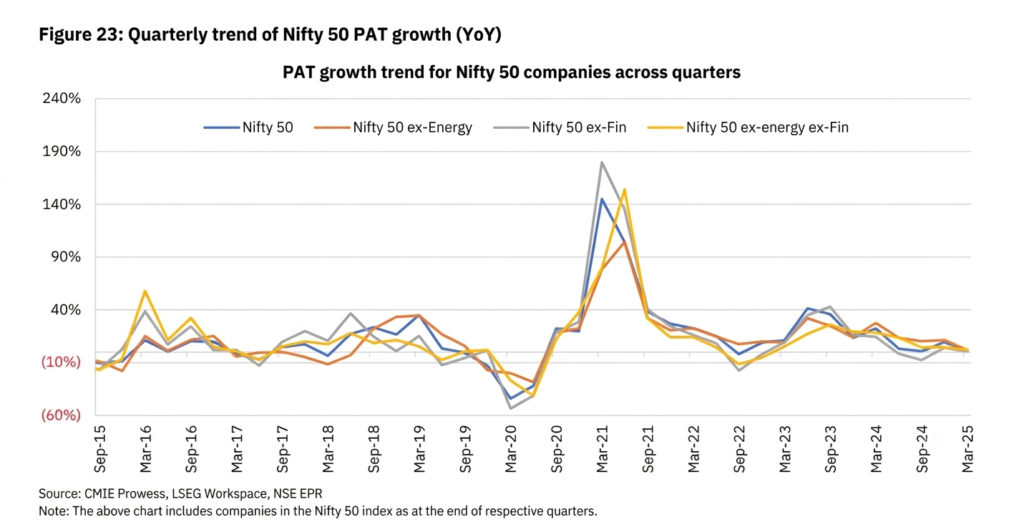
Disappointing results or weaker earnings growth expectations can reduce stock prices. Nifty 50 companies saw profit growth slow sharply, with aggregate net profit growth falling from 26% in FY24 to 5.5% in FY25 and 4.5% in FY26. Slowing earnings growth combined with elevated market valuations can increase the risk of a market correction.
Higher Valuation:
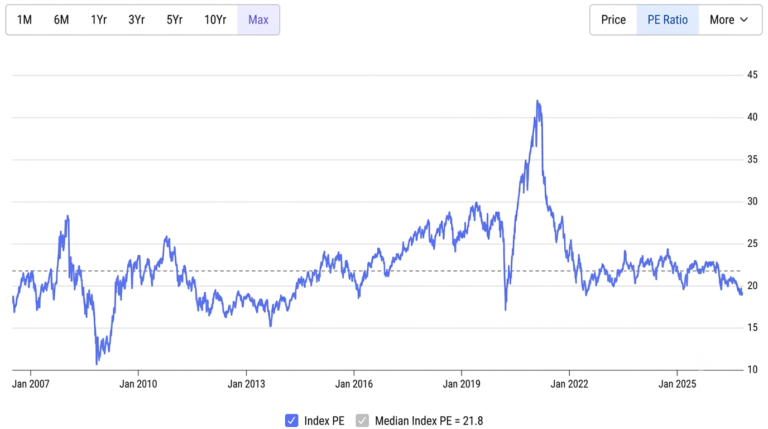
Higher valuations can limit gains even with a strong economy, corporate fundamentals, and other key metrics. Nifty 50’s price-to-earnings (P/E) multiple reached around 24x in late 2024, significantly above its historical average. However, after nearly two years of consolidation, the valuation has declined to around 19x, below its 20-year median of 21.8x.
Investor sentiment:
Fear and uncertainty can intensify selling, even when the underlying business outlook has not changed significantly. For instance, foreign investors have been consistently selling Indian equities, offloading more than ₹10 lakh crore over the past three years.
| Year | FII Selling Cash | DII Buying Cash |
|---|---|---|
| 2026 (as of 30 October 2026) | ₹4,45,273 crore | ₹7,11,660 crore |
| 2025 | ₹3,06,419 crore | ₹7,88,184 crore |
| 2024 | ₹3,02,434 crore | ₹5,26,545 crore |
History shows that major market corrections are an inevitable part of equity investing, although their timing cannot be predicted. The dot-com bubble burst in 2000, the Global Financial Crisis in 2008 and the COVID-19 crash in 2020 are notable examples.
Each episode had a different trigger, but all resulted in sharp declines (approximate fall shown in the chart below) in equity markets. This reminds us that prolonged bull markets do not eliminate the risk of a significant correction. Apart from these crashes, corrections of 10-20% in equities are also quite common from time to time.
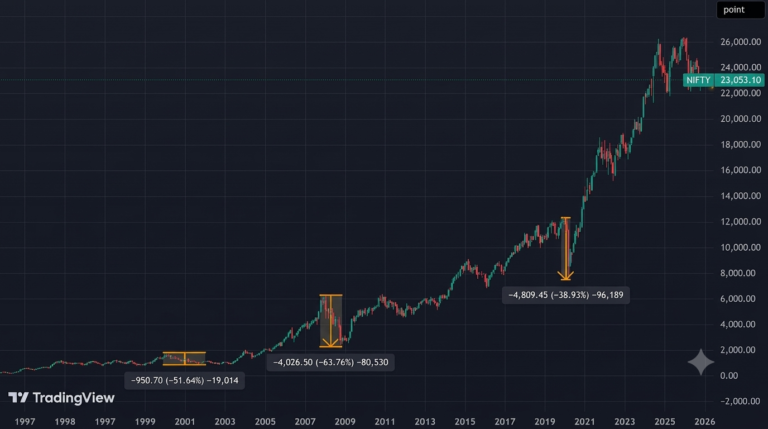
Historically, markets have eventually recovered from major crashes and gone on to touch new highs. Recovery periods have varied from one downturn to another. This highlights the importance of patience and a long-term perspective when investing in equities.
Should You Invest in Mutual Funds When the Market Falls?
This suggests that investing in mutual funds during a market decline can make sense if you have a long investment horizon, adequate emergency savings, and the financial capacity to withstand the inherent volatility of equities.
Lower market prices let investors buy more units with the same amount of money. However, a decline alone is not enough to justify investing. Suppose you invest in an equity mutual fund when its Net Asset Value (NAV) is ₹50. If the NAV falls to ₹40, the same investment amount buys more units.
If the fund eventually recovers, those additional units may contribute to your returns. However, the NAV could fall further to ₹30 or even lower. In that case, your investment will keep losing value until it recovers. No one knows when it will recover.
Nikkei 225 touched a new all-time high in 2024 as the country moved away from prolonged deflation towards moderate inflation. Nonetheless, investing in mutual funds during a market downturn can help you buy more units than with regular contributions and average a lower purchase price over time.
Before deciding if it’s good to invest when the market is down, consider three questions:
- Can you leave the money invested for the required period?
- Do you have sufficient savings for emergencies and near-term expenses?
- Can you tolerate a further decline without being forced to sell?
If you can answer yes to these questions, it may be wise to stick with a sound long-term investment plan. If you need the money soon or can’t afford further losses, reconsider your investment strategy instead of continuing to invest just because prices have fallen.
How Does SIP Work When the Market Falls?
A SIP allows investors to invest a fixed amount at regular intervals, usually every month, into a mutual fund scheme. For example, suppose Rohan invests ₹10,000 every month into an equity mutual fund. Instead of worrying whether the market is high or low, he continues investing regularly.
Suppose an investor contributes ₹10,000 every month for six months.
| Month | NAV (₹) | Monthly Investment (₹) | Units Purchased |
|---|---|---|---|
| January | 50 | 10,000 | 200.0 |
| February | 45 | 10,000 | 222.2 |
| March | 40 | 10,000 | 250.0 |
| April | 42 | 10,000 | 238.1 |
| May | 48 | 10,000 | 208.2 |
| June | 52 | 10,000 | 192.3 |
| Total | N/A | 60,000 | 1,310.8 |
| Average Cost Per Unit | ₹45.8 | — | — |
Although the average NAV during the six months is ₹46.2, the investor’s average purchase cost is ₹45.8, demonstrating the benefit of systematic investing. This is why SIP remains one of the most effective wealth creation tools for long-term investors
Over time, he buys more units when markets fall and fewer units when markets rise. This process is known as rupee cost averaging. The biggest advantage of SIP is that it builds investing discipline while reducing the need to time the market. You can also use a SIP calculator to calculate the estimated corpus.
Should You Stop Your SIP During a Market Crash?
Stopping your SIP just because the market has fallen could disrupt your long-term investment plan. If your financial goals haven’t changed, your income is stable, and you can withstand further market declines, it may be worth continuing your SIP. As shown above, the market usually recovers over time.
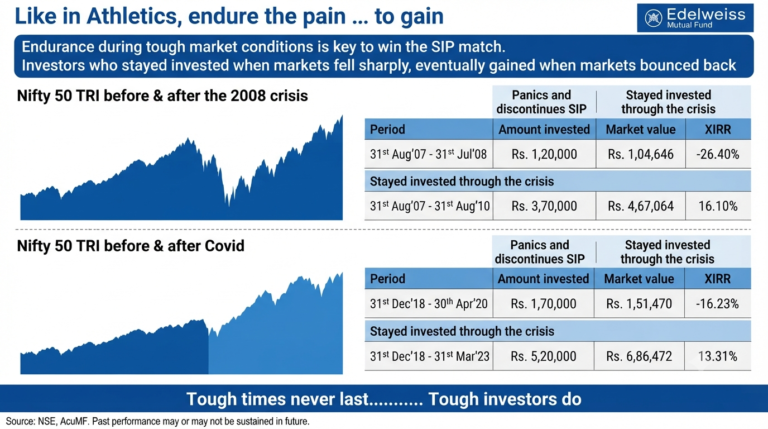
Data supports this behaviour. According to an Edelweiss Mutual Fund study, an investor who discontinued their SIP during the crisis recorded a loss of 26.4%. While an investor who continued investing through the downturn generated a 16.1% XIRR over the longer period.
This highlights how staying invested through market volatility can help long-term investors benefit from a subsequent recovery.
However, if your financial circumstances or risk appetite have changed, review your plan before deciding whether to continue, pause, or stop investing. Redeeming your existing investments during a correction is generally not advisable, as it may lock in losses and prevent you from benefiting from a potential market recovery.
Before deciding whether to stop your SIP during a market crash, consider the following:
- Investment Horizon: Equity mutual funds are generally better suited for long-term goals than for money you need soon.
- Financial Stability: If your income is uncertain or you need money for essential expenses, it may be important to protect your finances.
- Risk Tolerance: If market declines are causing significant stress, review whether your current asset allocation is appropriate.
- Original Investment Objective: A short-term decline does not mean that the fund or investment strategy has become outdated.
Ideally, you can review your contributions when your situation changes. The key is to avoid making decisions based solely on fear or short-term market movements.
Is a Market Correction a Good Time to Start a SIP?
A market correction can provide an opportunity to begin investing at lower prices, but you do not need to predict the market bottom before starting a SIP. If you have a long-term goal, enough emergency savings, and can tolerate volatility, regular investing may help you participate in the market at different price levels.
If you are wondering whether a market correction is a good time to start an SIP, consider these factors before investing:
- Investment horizon: Make sure your money can remain invested for an appropriate period (at least five years), particularly if you choose an equity-oriented fund.
- Emergency savings: Instead of investing all your cash, keep an emergency fund for unexpected expenses.
- Risk tolerance: Choose an investment category that suits your risk tolerance.
- Regular income: Ensure that the monthly SIP amount is set at a level that you can easily afford, even if your expenses increase.
- Financial goals: Link your investment to a specific goal, such as retirement or another long-term financial goal.
Overall, the decision about whether to invest in mutual funds during a market fall should be based on financial readiness and risk tolerance.
What Should You Do When the Market Falls?
When the stock market declines, review your financial goals, mutual funds in the portfolio, and asset allocation. Avoid reacting impulsively to every market movement. Your response should depend on whether the downturn altered your financial goals and whether your portfolio still aligns with those goals.
Here are some practical steps to consider when deciding what to do when the stock market falls.
- Review your financial goals: If your goal is still several years away, a short-term market decline may not necessitate any immediate changes. If you need the money soon, protecting the amount you have accumulated may become more important.
- Check your asset allocation: Review how much of your portfolio is invested in equity, debt, and other assets. If the allocation of your portfolio to equities has increased or decreased from its initial level, you can adjust it, either by reducing or increasing it, in line with your risk tolerance.
- Avoid checking NAV every day: Checking NAV movements daily generally create anxiety and encourage emotional decisions. This can prompt you to take impulsive decisions like stopping SIPs or redeeming investments based on short-term market movements. Instead, review your investments periodically and focus on whether they still suit your goals.
- Review mutual fund: Evaluate the fund’s investment objective, fund manager, portfolio composition, risk profile, and performance over an appropriate period. If there is no material change, you may not need to make any changes to your portfolio. A market decline alone does not mean the fund is unsuitable.
- Don’t chase past returns: Switching to a fund simply because it has delivered better recent returns can lead to performance-driven decisions.
These steps can help you invest during stock market volatility with a clearer process instead of making decisions under pressure.
Common Mistakes Mutual Fund Investors Make During a Market Fall
Market declines often test investors’ patience and discipline. During such periods, emotional decisions can turn temporary market volatility into avoidable losses. Some mistakes can also expose investors to risks that may not align with their financial goals or risk appetite.
- Panic Selling: Selling mutual fund investments out of fear can turn temporary losses into actual losses. It can also prevent you from participating in a potential market recovery.
- Stopping SIPs: A market correction doesn’t automatically make a long-term SIP ineffective. Stopping contributions during a downturn may mean missing the opportunity to accumulate more units at lower NAVs.
- Investing Borrowed Money: Don’t invest with borrowed money. Market declines can reduce your portfolio value, but loan repayments and interest obligations continue.
- Switching Funds: Moving from one fund to another based solely on recent performance can lead to poor decisions, additional costs, and investments that may not align with your financial goals.
- Expecting a Quick Recovery: Markets do not always recover quickly. A downturn can last months or even years. Some funds may take longer to regain their previous values.
- Trying to Time the Market: Waiting for the perfect entry point can keep you out of the market for long periods. Predicting when a market will bottom is difficult, even for experienced investors.
A good investment process should account for the inherent uncertainty of the equity market. The goal isn’t to avoid every downturn, but to ensure your investment decisions align with your financial situation.
Final Takeaway
A falling market can create uncertainty, but it does not automatically mean you should stop investing. If you have long-term goals, adequate financial reserves, and can tolerate market volatility, continuing your SIP may be a reasonable approach. However, whether to invest more during a decline should depend on your financial readiness and risk appetite.
Before deciding whether to invest in mutual funds during a market crash, review your financial goals, investment horizon, and risk tolerance. Avoid panic decisions, protect your emergency savings, and review your portfolio periodically.
A registered Mutual Fund Distributor like Mutualfundwala can also help you review your portfolio and assess whether your investments still align with your goals. The goal isn’t to time the market. It’s to follow a disciplined investment approach you can sustain through market cycles.
FAQs
1. Should I invest in mutual funds when the market falls?
f you have an appropriate investment horizon, enough emergency savings, and can withstand potential losses, you might consider investing. A market downturn can lower your entry price, but it does not guarantee better future returns.
2. Should I continue my SIP during a market crash?
If your financial goals have not changed, it may be appropriate to continue. As we discussed above, the market has historically recovered on most occasions after a downturn.
3. What happens to mutual funds when the market crashes?
When the value of the stocks included in an equity mutual fund declines, the fund’s NAV typically also falls. The extent of this decline depends on the fund’s portfolio and investment strategy. Debt and hybrid funds may experience a lower decline than pure equity funds.
4. Can I lose money if I invest during a market correction?
Yes, the market could fall further after you invest, reducing your mutual fund’s value. A correction doesn’t guarantee a quick recovery or positive returns. However, historical data suggests markets have eventually recovered from major downturns and reached new highs.
5. Should I increase my SIP when the market is down?
Increasing your SIP may be an option if your income, savings, investment horizon, and risk tolerance support a higher contribution. Do not increase it simply because prices have fallen.
6. Is it better to invest a lump sum or through SIP during a market fall?
A lump sum invests your available money at once, while an SIP spreads contributions over time. A lump sum gives immediate market exposure but risks buying just before another decline. A better approach may be to stagger your lump-sum investment and let the SIP continue as usual.