
 Gaurav
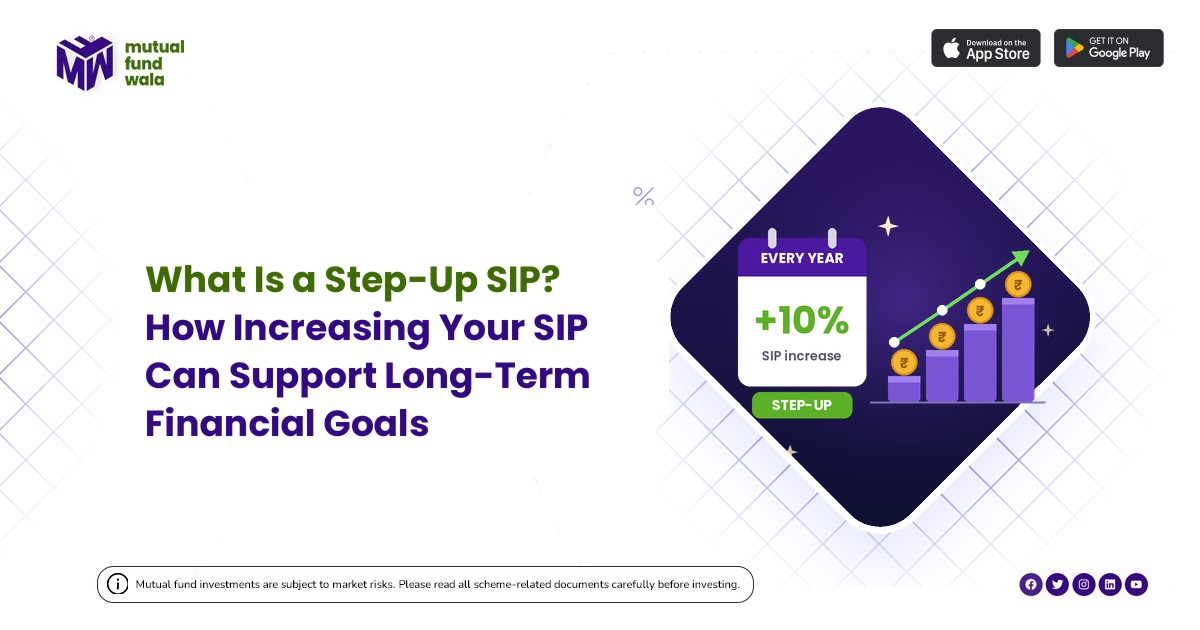
A step-up SIP (also called a top-up SIP) is a SIP in which your monthly instalment increases automatically at set intervals, usually once a year, by a fixed amount or a percentage. For example, a ₹5,000 SIP with a 10% annual step-up becomes ₹5,500 in the second year and ₹6,050 in the third year.
Starting a SIP is one way to invest regularly in mutual funds. But as your income rises, keeping the SIP amount unchanged means your investment does not grow with your financial capacity. For long-term goals like retirement or a child’s education, a step-up SIP lets your contributions grow as your income grows. That helps your investments keep pace with inflation and rising goal costs.
How Does a Step-Up SIP Work?
A regular SIP keeps the investment amount the same every month. A step-up SIP starts with an initial amount and then increases it at predefined intervals, based on the step-up amount or percentage you choose when setting it up.
For example, suppose you start a SIP of ₹5,000 per month with a 10% annual step-up:
| Year | 1 | 2 | 3 | 4 | 5 |
|---|---|---|---|---|---|
| Monthly SIP | ₹5,000 | ₹5,500 | ₹6,050 | ₹6,655 | ₹7,321 |
A few practical points apply to how step-ups work:
- Step-up frequency: Annual step-ups are the most common. Some platforms also offer half-yearly or quarterly step-ups.
- Step-up multiples: The increase may need to be in multiples set by the scheme or platform, for example ₹100 or ₹500.
- Fixed or percentage: Some platforms allow only a fixed rupee increase, while others allow a percentage.
Since these rules vary between fund houses and platforms, check the available step-up options before starting.
Benefits of Step-Up SIP
- Helps increase investments with income: As your salary or business income rises, a step-up SIP lets you direct part of that additional income towards investments. For example, an investor earning ₹50,000 a month may start with a ₹5,000 SIP and raise it gradually as income grows, instead of keeping it at ₹5,000 for years.
- Can help build a larger corpus: More money invested over time means more money that can participate in compounding. The longer the investment period, the more time these additional contributions have to potentially grow.
- Helps maintain investment discipline: A predefined step-up schedule removes the need to decide every year whether to increase your SIP.
- Can help account for inflation: The cost of a financial goal generally rises with inflation. A retirement corpus that seems sufficient today may not be enough 20 years later. Periodic increases help your contributions keep pace.
- Useful for long-term goals: Step-up SIPs can be considered for goals such as retirement, children’s education or long-term wealth creation.
How a Step-Up SIP Can Support Long-Term Financial Goals
A step-up SIP is particularly relevant when your goal is several years away. Take an investor saving for retirement 20 years from now. Starting with a very high SIP may not be practical early in their career. At the same time, keeping the SIP unchanged for 20 years may leave a contribution that becomes small compared with future income and future goal costs.
A step-up approach lets the investor start with a manageable amount and increase it gradually, keeping investments aligned with their earning cycle.
Here’s how a ₹5,000 starting SIP could compare, with and without a 10% annual step-up, across common long-term goals, assuming an illustrative 12% p.a. return:
| Goal (Illustrative) | Horizon | Regular SIP Corpus | 10% Step-Up SIP Corpus |
|---|---|---|---|
| Child's Higher Education | 15 years | ₹24.98 lakh | ₹42.99 lakh |
| Long-Term Wealth Creation | 20 years | ₹49.46 lakh | ₹98.46 lakh |
| Retirement | 25 years | ₹93.94 lakh | ₹2.12 crore |
Illustrative figures only. The step-up version also invests considerably more money over each period. Mutual fund returns are market-linked and not guaranteed.
To connect each SIP to a specific target, read our guide on goal-based investing.
Fixed Amount vs Percentage Step-Up SIP
A step-up SIP can generally be structured in two ways:
- Fixed amount step-up: You increase your monthly SIP by the same rupee amount every year. For example, you start with ₹5,000 and add ₹1,000 every year.
- Percentage step-up: You increase your SIP by a fixed percentage every year. For example, you start with ₹5,000 and increase it by 10% every year.
| Particulars | Fixed Amount Step-Up | Percentage Step-Up |
|---|---|---|
| Starting SIP | ₹5,000 | ₹5,000 |
| Annual Increase | ₹1,000 | 10% |
| Year 2 SIP | ₹6,000 | ₹5,500 |
| Year 3 SIP | ₹7,000 | ₹6,050 |
| Increase Pattern | Same rupee amount every year | Rupee increase grows every year |
| May Suit | Predictable, steady income growth | Income expected to grow in percentage terms |
Which one invests more? It depends on the starting amount, the step-up size and the investment period. With a ₹5,000 starting SIP, a ₹1,000 fixed step-up actually invests more than a 10% step-up over the first 20 years. The 10% step-up overtakes it from year 21 onward, because its yearly increase keeps growing on a higher base.
| Step-Up Option (₹5,000 start, 20 years, 12% p.a.) | Total Invested | Estimated Corpus |
|---|---|---|
| +₹500 every year | ₹23.40 lakh | ₹78.46 lakh |
| +₹1,000 every year | ₹34.80 lakh | ₹1.07 crore |
| +10% every year | ₹34.36 lakh | ₹98.46 lakh |
*Illustrative figures only. Mutual fund returns are market-linked and not guaranteed.
Step-Up SIP Example and Return Calculation
Consider an investor who starts a monthly SIP of ₹5,000 and increases it by 10% every year for 20 years, at an illustrative annualised return of 12%.
| Particulars | Amount |
|---|---|
| Initial Monthly SIP | ₹5,000 |
| Annual Step-Up | 10% |
| Monthly SIP in Year 20 | ₹30,580 |
| Investment Period | 20 years |
| Assumed Return | 12% p.a. |
| Total Investment | ₹34.36 lakh |
| Estimated Corpus | ₹98.46 lakh |
| Estimated Gains | ₹64.09 lakh |
These figures are only an illustration. Mutual fund returns are market-linked and are not fixed or guaranteed.
What Step-Up Percentage Should You Choose?
There is no single step-up percentage that suits everyone. A higher step-up increases the potential corpus, but it also sharply raises your future monthly commitment. The table below compares different step-up rates for the same ₹5,000 starting SIP over 20 years at 12% p.a.:
| Annual Step-Up | Monthly SIP in Year 20 | Total Invested | Estimated Corpus |
|---|---|---|---|
| 0% (Regular SIP) | ₹5,000 | ₹12.00 lakh | ₹49.46 lakh |
| 5% | ₹12,635 | ₹19.84 lakh | ₹68.01 lakh |
| 10% | ₹30,580 | ₹34.36 lakh | ₹98.46 lakh |
| 15% | ₹71,160 | ₹61.47 lakh | ₹1.50 crore |
Illustrative figures only. Returns are market-linked and not guaranteed.
At a 15% step-up, the monthly SIP in year 20 is over ₹71,000, which may not be sustainable unless income grows at a similar pace. A useful reference point is to keep the step-up rate at or below your expected income growth.
Step-Up SIP vs Regular SIP: Key Differences
The main difference is how the investment amount changes over time.
| Feature | Regular SIP | Step-Up SIP |
|---|---|---|
| Monthly Investment | Constant | Increases periodically |
| Income Adjustment | Requires manual increase | Predefined, automatic increase |
| Long-Term Contribution | Lower if unchanged | Higher |
| Potential Corpus | Based on constant contribution | Can be higher due to higher contributions |
| Budget Requirement | Easier to budget | Increases over time |
Here's how the same ₹5,000 starting SIP compares with and without a 10% annual step-up, at 12% p.a.:
| Investment Period | Regular SIP Corpus | 10% Step-Up SIP Corpus |
|---|---|---|
| 10 years | ₹11.50 lakh | ₹16.70 lakh |
| 15 years | ₹24.98 lakh | ₹42.99 lakh |
| 20 years | ₹49.46 lakh | ₹98.46 lakh |
| 25 years | ₹93.94 lakh | ₹2.12 crore |
| 30 years | ₹1.75 crore | ₹4.37 crore |
Illustrative figures only. Returns are market-linked and not guaranteed.
The difference is substantial, but the step-up SIP also requires considerably more money to be invested. Over 20 years, for example, the regular SIP invests ₹12 lakh while the 10% step-up SIP invests ₹34.36 lakh. The higher corpus does not come only from returns; a significant part comes from the additional money invested over time.
Neither approach is automatically suitable for every investor. The choice depends on income growth, expenses, financial goals and investment capacity.
Step-Up SIP Rules: Caps, Mandate Limits, Pause and Stop
Step-up SIP features can vary across mutual fund houses and investment platforms. Before setting one up, check the applicable limits and options on your platform.
- Step-up cap: Some platforms allow you to set a maximum SIP amount or an end date for annual increases. Once the cap is reached, the SIP may continue at the last instalment amount.
- Mandate limit: The bank mandate used for the SIP may have a maximum debit limit. Make sure the limit can accommodate future step-up instalments.
- Existing SIP: Depending on the platform, you may be able to add a step-up to an existing SIP, while some platforms may require a new SIP registration.
- Pause or stop: Options for pausing or removing a step-up vary by platform. In some cases, the SIP can continue at the existing amount; in others, a new SIP may need to be registered.
- Cancellation and redemption: Stopping a SIP generally does not mean redeeming existing units. Any applicable exit load depends on the mutual fund scheme and the units being redeemed.
How to Start a Step-Up SIP
You can consider a step-up SIP when you have a regular income and expect your investment capacity to increase over time. These steps can help:
- Define your goal: Identify what you are investing for and when you will need the money.
- Decide the initial SIP: Choose an amount that fits comfortably within your current budget.
- Choose fixed or percentage step-up: Pick a type and rate that are realistic for your expected income growth.
- Set the frequency and cap: Select annual or half-yearly increases (if available) and a maximum SIP amount, if you want one.
- Check your bank mandate limit: Make sure it can accommodate future stepped-up instalments.
- Choose the investment horizon: Longer periods give contributions more time to compound.
- Review periodically: Your income, expenses and priorities can change, so revisit the step-up when they do.
- Keep an emergency fund: Investments should not replace money needed for near-term emergencies.
For example, an investor expecting regular annual increments may consider a 10% step-up. Another investor with steady but slower income growth may prefer adding ₹1,000 every year. The important point is to choose an increase that can realistically be maintained.
How to Start a Step-Up SIP With MutualFundWala
Download the MutualFundWala app or sign up on the website using your mobile number and email.
Complete your KYC, or verify it if it’s already done.
Choose a fund and start a SIP, then select the step-up option and set your step-up amount or percentage.
Set up your bank mandate (eNACH) with a limit that covers future stepped-up instalments.
How to Calculate Step-Up SIP Returns
A calculator helps you estimate how a higher investment amount over time may affect the potential value of your investment. You can estimate step-up returns with a regular SIP calculator by running each year’s SIP amount separately, or use the formula below. To see the regular SIP figures first, use our SIP Calculator.
How the calculation works: Each monthly instalment compounds for the months remaining until the end of the investment period, and the instalment amount increases every 12 months by the chosen step-up.
Future Value = Σ [ P × (1 + g)^Y × (1 + r)^(N − m) ], for each month m from 1 to N
Where:
- P = starting monthly SIP
- g = annual step-up rate
- Y = number of completed years before month m
- r = monthly rate of return
- N = total number of months
Methodology for all illustrations in this article: 12% p.a. compounded monthly (1% per month), SIP invested at the end of each month, step-up applied every 12 months. Figures are rounded and are for illustration only.
Conclusion
A step-up SIP lets you gradually increase your mutual fund investments instead of keeping the SIP amount unchanged. For long-term financial goals such as retirement, a child’s education or wealth creation, it helps your contributions grow with your income and keep pace with rising costs over time.
The key is to choose a starting SIP that is affordable, a step-up rate that can realistically be maintained, and sensible limits such as a cap and an adequate mandate amount. Remember that a large part of the higher corpus comes from making higher contributions over time. Mutual fund returns remain market-linked and are not guaranteed.
FAQs
A step-up SIP is a SIP in which the monthly contribution increases automatically at set intervals, usually yearly, by a fixed amount or a percentage.
It lets you start with an affordable amount and increase it as income grows. Over long periods such as 15 to 25 years, this helps your contributions keep pace with inflation and rising goal costs for retirement or a child's education.
Yes. Step-up SIP and top-up SIP are two names for the same facility, which increases your SIP instalment at predefined intervals.
Not automatically. A step-up SIP leads to higher contributions and can potentially build a larger corpus, but it also requires investing more money over time. The right choice depends on your income, expenses and goals.
There is no single right percentage. Many investors consider a rate at or below their expected income growth, such as 5% to 10%, so that future instalments remain affordable.
No. A step-up SIP increases the amount invested, not the rate of return. The final value depends on the fund's performance and the investment period.