

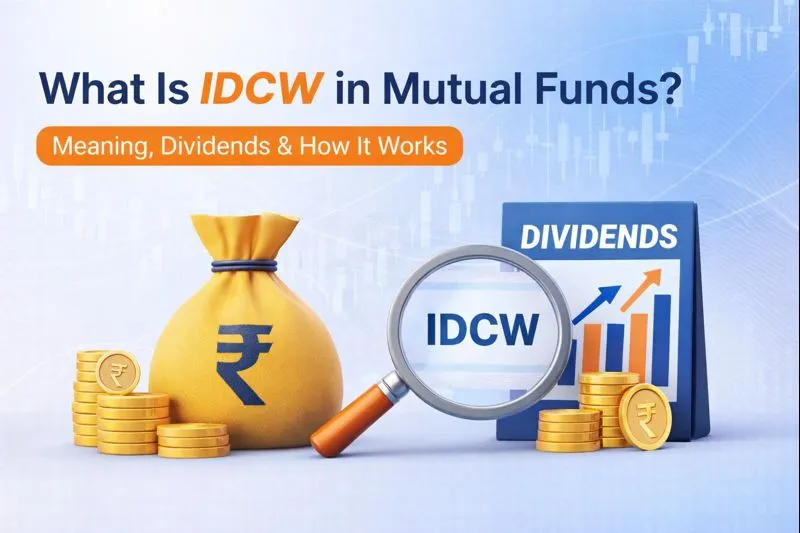
Many investors who scan mutual fund fact sheets often pause when they see the term IDCW. It usually appears next to scheme names and can feel technical at first glance. This often leads to a common question: what is IDCW in mutual fund, and how does it affect returns?
Earlier, this option was widely known as the dividend option, which created a certain perception among investors. Over time, regulators stepped in to bring more clarity and transparency. As a result, the term IDCW replaced the word dividend. Understanding what it means—and how it works in practice—can help investors avoid confusion and set the right expectations from their mutual fund investments.
To understand the IDCW meaning in mutual fund, it helps to first know what the term stands for. IDCW means Income Distribution cum Capital Withdrawal. This name itself explains the nature of the payout.
When a fund declares IDCW, it distributes money from the scheme to investors. This payout is not extra income generated by the fund. Instead, it comes from the profits already made or from the investor’s own invested capital. That is why the NAV of the fund falls after an IDCW payout.
In simple terms, IDCW is a partial withdrawal of your own investment or gains, paid out by the mutual fund when the fund house decides to distribute surplus.


One of the most searched questions is do mutual funds give dividends, and the honest answer requires some nuance. Mutual funds do not generate dividends the way stocks do. Companies earn profits and declare dividends from those profits. Mutual funds, on the other hand, only invest money on behalf of investors.
Earlier, payouts from mutual funds were labelled as dividends, which made many investors believe they were receiving extra income. To correct this misunderstanding, SEBI changed the terminology to IDCW.
So when investors ask do mutual funds give dividends, the accurate answer is that mutual funds distribute money from their existing corpus, not from fresh income. The total value of your investment adjusts accordingly after the payout.
When choosing a mutual fund, investors usually come across two options—Growth and IDCW.
In the growth option, all profits remain invested in the fund. This allows compounding to work uninterrupted over time. The NAV keeps rising as long as the fund performs well.
In the IDCW option, the fund periodically pays out a portion of the gains or capital. After each payout, the NAV falls to the extent of the distribution. While investors receive cash in hand, the invested value reduces.
This difference becomes important for long-term planning. Investors who want their money to compound over many years often prefer the growth option. Those who want periodic cash flows may look at IDCW, but only after understanding its impact.
Earlier, funds that offered payouts were commonly referred to as dividend mutual funds. Today, these are the same schemes but renamed under the IDCW framework.
The investment strategy of the fund does not change. What changes is the clarity around payouts. The new naming ensures investors understand that the money distributed reduces the fund’s NAV and is not an additional return.
For anyone still using the term dividend mutual funds, it helps to remember that these are now officially IDCW options, and the mechanics remain the same.
IDCW is not guaranteed. A fund house declares IDCW only if it has distributable surplus and if the fund manager believes it is appropriate to distribute it. There can be long periods with no payouts at all.
Also, IDCW can be of two types—regular IDCW and IDCW reinvestment. In the reinvestment option, the payout amount is reinvested back into the same scheme at the ex-IDCW NAV, instead of being credited to your bank account.
Investors should note that IDCW frequency does not indicate fund quality. A fund that does not declare IDCW can still be performing very well.
Taxation is another important aspect of understanding what is IDCW in mutual fund. IDCW payouts are taxable in the hands of the investor as per their income tax slab.
Earlier, there was a dividend distribution tax paid by fund houses. That system has been removed. Today, IDCW is added to the investor’s income and taxed accordingly.
Because of this, many investors in higher tax brackets prefer the growth option, where tax is paid only at the time of redemption and often at lower capital gains rates.
IDCW may suit investors who need periodic cash flows, such as retirees or those using mutual funds as a supplemental income source. However, it should not be mistaken for stable or assured income.
The amount and timing of IDCW payouts are uncertain, and the NAV impact needs to be clearly understood. For long-term wealth creation, IDCW is usually less efficient than growth.
Platforms like mutual fund wala often guide investors to evaluate IDCW only after assessing cash flow needs, tax impact, and investment horizon.
Many investors still believe IDCW means extra returns. This is one of the biggest misconceptions. IDCW does not increase your total wealth. It only changes the form in which you receive it—partly as cash and partly as remaining investment value.
Another misconception is that frequent IDCW payouts mean a fund is performing better. In reality, payouts depend on fund house policy and market conditions, not just returns.
Understanding these aspects helps investors make informed decisions rather than chasing payouts.
Ans: IDCW stands for Income Distribution cum Capital Withdrawal. It means the fund distributes money from its surplus or capital, which reduces the NAV after payout.
Ans: For beginners, IDCW means the fund is paying you part of your gains or investment as cash, instead of keeping everything invested.
Ans: No. Mutual funds do not generate dividends like stocks. What they distribute is money from their own corpus, now called IDCW.
Ans: Yes. Dividend mutual funds is the older term. These schemes are now officially called IDCW options.
Ans: IDCW is not better or worse—it serves a different purpose. Growth is generally better for long-term wealth creation, while IDCW suits investors who need periodic cash flows.
About the Author

Mr Shashi Kant Bahl
Mr. Shashi Kant Bahl is a mutual fund professional with nearly 20 years of experience in the financial services industry. Since 2005, he has helped over 10,000 investors manage their mutual fund investments and build long-term wealth. His firm currently manages assets of over ₹734 crore (AUM).
Disclaimer: Mutual fund investments are subject to market risks. Read all scheme-related documents carefully.
Recent Post



© 2026 MutualFundWala | AMFI Registered Mutual Fund Distributor | ARN-275889, Valid by 06-09-2029 | All rights reserved
AMFI-registered mutual fund distributor helping investors across India invest simply, securely, and transparently since 2005.
© 2026 MutualFundWala. All rights reserved.
